How Airbus Is Approaching Exoskeleton Deployment: A Case Study in Caution, Data, and Worker Choice
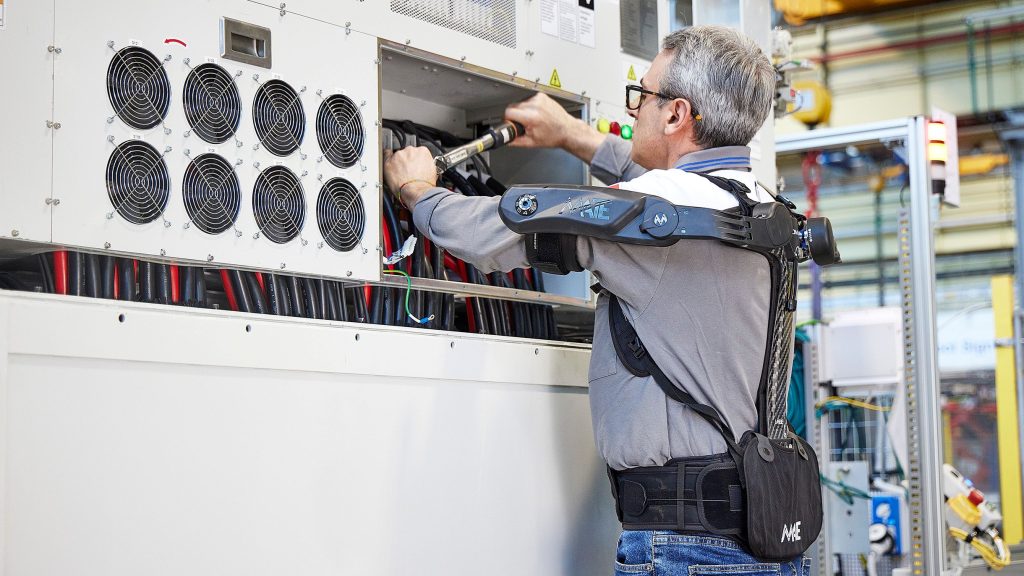
When you build aircraft for a living, the ergonomic challenges are anything but ordinary. Workers on Airbus's final assembly lines perform tasks at every height — from crouching inside wing structures to reaching overhead for fuselage panel installations. The work is precise, physically demanding, and takes place in congested spaces where bulky equipment simply cannot fit.
Airbus's approach to exoskeleton adoption offers a valuable case study for any organization considering worker augmentation technology.
The Challenge: Aviation-Grade Ergonomics
Varying heights
Floor to overhead
Congested spaces
Narrow wing gaps
Complex tasks
Each aircraft unique
Long shifts
8-10 hour fatigue
The Journey: From Skepticism to Pilot Programs
Early exploration in the early 2000s was met with skepticism from occupational health professionals who raised legitimate concerns about shifting pain points and insufficient data.
The turning point came over the past five years, driven by three developments:
France's INRS and Canada's IRSST published evaluation frameworks for exoskeleton deployment.
Data from automotive, logistics, and construction gave Airbus comparable reference points.
Passive exoskeletons became lighter, better-adjustable, and more comfortable than early bulky suits.
The Approach: TOP Principle + Voluntary Adoption
1. The TOP Principle
Airbus follows the TOP (Technical → Organizational → Personal) hierarchy of ergonomic controls — consistent with OSHA's hierarchy and advocated by Fraunhofer IPA:
TOP Hierarchy of Ergonomic Controls
Airbus exhausts Technical and Organizational interventions before introducing wearable technology
"This is a critical point: Airbus does not deploy exoskeletons as a first-line solution. The company exhausts technical and organizational interventions before introducing wearable technology."
2. Voluntary Participation
Airbus runs its program on a volunteer-only basis. Workers choose whether to participate — the program is positioned as an additional tool, not a mandate. The Santa Clara University study found that while exoskeletons reduced lower back exertion by 22.67 points, usage likelihood scored only 4.44 out of 10, underscoring the importance of worker buy-in.
The Technology Choice: Passive Over Active
In the confined spaces of aircraft assembly, the trade-offs of active exoskeletons become liabilities:
Passive vs. Active Exoskeletons in Aerospace
Key Takeaways for Your Organization
1. Start with the TOP principle
Exoskeletons supplement good ergonomics — they do not replace it. Fix the work before augmenting the worker.
2. Make participation voluntary
Worker buy-in affects outcomes and provides critical feedback data for program improvement.
3. Match the device to the environment
In congested spaces, lighter passive devices outperform powered alternatives.
4. Use industry guidance
INRS, IRSST, and Fraunhofer frameworks reduce guesswork and provide credible evaluation protocols.
What's Next
Airbus continues to expand its pilot program. For other organizations, the message is clear: a 30-day pilot in one high-risk area is now a realistic starting point — and the lessons from early adopters make it easier than ever to begin.
The Workplace Ergonomics Brief is a weekly newsletter by Next Reality Robotics. We help safety leaders, HR professionals, and operations teams learn from real-world deployments and make informed decisions about worker augmentation.
Subscribe to the newsletter →