
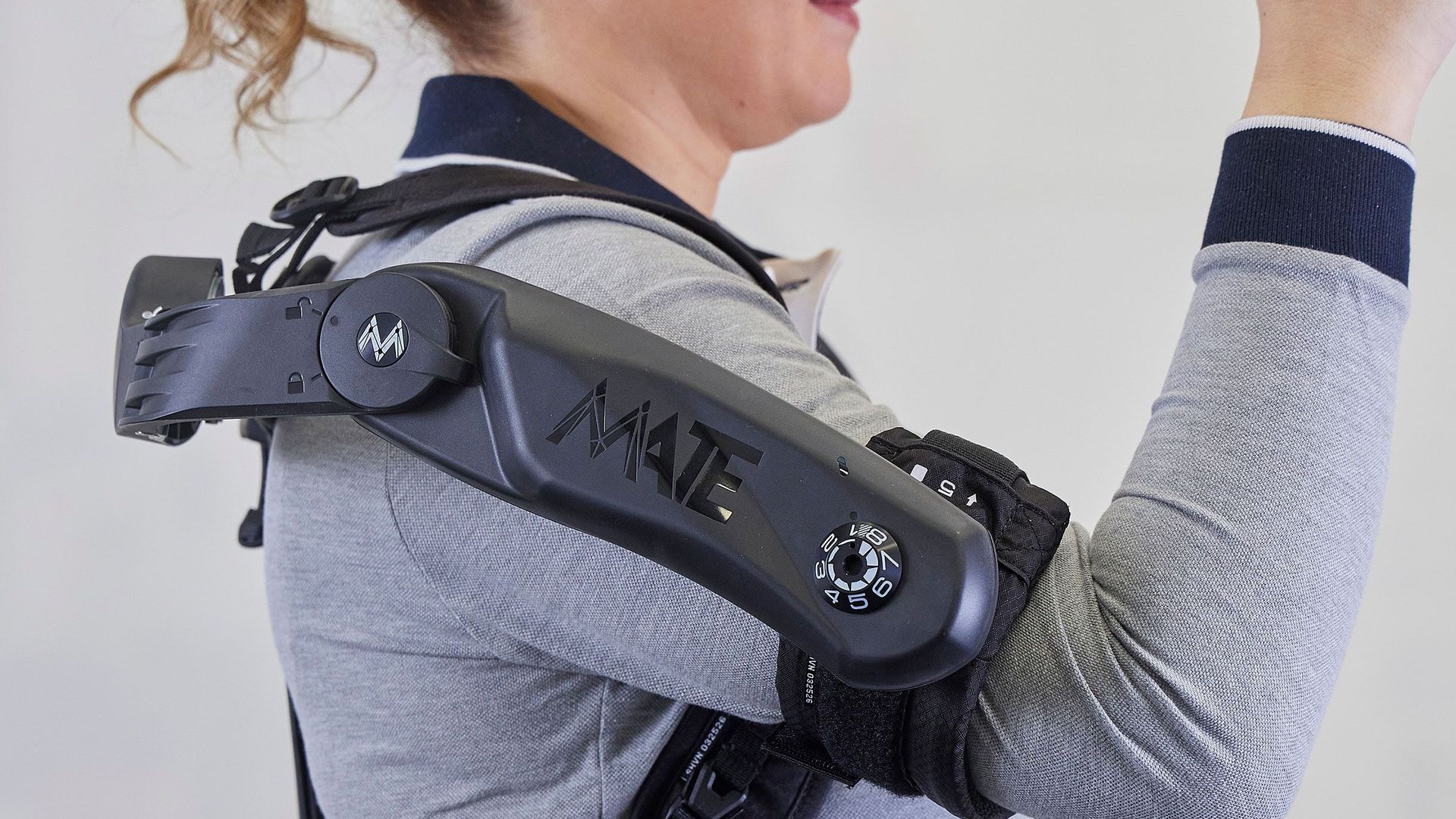
Comau's MATE-XT GO: A New Milestone in Accessible Workplace Ergonomics
How a lighter, certified, and more affordable exoskeleton is bringing industrial-grade ergonomic support to small and medium-sized businesses
The Launch That Changes the Equation
On February 12, 2026, Comau — the Italian industrial automation leader with over five decades of robotics expertise — unveiled the MATE-XT GO, a new wearable exoskeleton engineered to support workers' arms and shoulders during repetitive and overhead tasks. While the product itself is impressive, what makes this launch significant is not just what it does, but who it's designed for.
The MATE-XT GO is certified as Category II Personal Protective Equipment (PPE) under EU Regulation 2016/425, making it ready for deployment in regulated professional environments. Weighing less than 3 kg and requiring just 30 seconds to put on and 10 seconds to remove, it represents a deliberate shift toward accessibility — bringing exoskeleton technology to small and medium-sized businesses (SMEs) that have historically been priced out of the market.
What Makes MATE-XT GO Different?
The MATE-XT GO is the latest addition to the MATE (Muscular Aiding Tech Exoskeleton) family, joining the MATE-XT (shoulder support), MATE-XT 4.0 (IoT-enabled shoulder support), and MATE-XB (lumbar/back support). What sets the GO variant apart is its deliberate focus on accessibility, affordability, and ease of deployment.
Marco Manavello, Chief Industrials Operations Officer at Comau, described the vision behind the launch:
"This achievement marks an important step forward in our vision of human-centric automation. Building on the real-world experience of more than 3,000 companies already using MATE exoskeletons at international level, and by listening closely to the needs of both workers and employers, we have further evolved the technology to deliver measurable, everyday benefits. MATE-XT GO combines a lighter design with professional certification and proven performance."
Why It Matters: The SME Gap in Exoskeleton Adoption
While the industrial exoskeleton market has grown rapidly — projected to reach $1.79–2.2 billion globally by 2030 — adoption has been heavily concentrated among large enterprises. The reasons are straightforward: enterprise-grade exoskeletons carry price tags of $3,500–$5,000+ per unit, require dedicated training programs, and demand integration support that small and mid-sized businesses simply cannot afford.
This leaves a vast portion of the workforce without access to ergonomic augmentation technology. According to recent data, U.S. manufacturing alone faces a 2 million worker shortage, driven by retirements and skills gaps. Meanwhile, workers over 55 will make up nearly a quarter of the labor force by 2026 — a demographic that stands to benefit enormously from ergonomic support that extends productive working years.
Addressing the Workforce Crisis
The timing of the MATE-XT GO launch could not be more strategic. Three structural trends are converging to create unprecedented demand for accessible ergonomic technology:
1. The Skills Gap. U.S. manufacturing faces a 2 million worker shortage as of early 2026, according to industry data. Factory employment has dropped by more than 70,000 since April 2025. Employers cannot simply hire their way out of this problem — they must extend the productive capacity of their existing workforce.
2. The Aging Workforce. Workers over 55 represented nearly a quarter of the U.S. labor force entering 2026. Physical demands of industrial jobs have not changed, but the workforce doing those jobs is older. Ergonomic augmentation is no longer a "nice to have" — it is becoming a retention and safety imperative.
3. The SME Opportunity. Small and medium-sized businesses constitute the majority of employment in manufacturing, construction, and logistics, yet they have been largely excluded from the exoskeleton revolution due to cost and complexity. A product that is lighter, more affordable, PPE-certified, and requires minimal maintenance changes this calculation entirely.
The Bigger Picture: A Maturing Exoskeleton Market
Comau's MATE-XT GO signals a broader maturation of the industrial exoskeleton market. Several indicators point to this shift:
From Pilots to Fleet Deployments. The industry is moving beyond 10-20 unit trials. Large employers are now evaluating 50-500+ unit enterprise purchases, and the availability of an affordable, certified option accelerates this trend. According to market analysis, passive exoskeletons accounted for approximately 30% of the $246 million industrial exoskeleton market in 2025, with manufacturing leading at 47.7% of global revenue.
Certification as a Market Catalyst. The Category II PPE certification of the MATE-XT GO is particularly significant. In regulated environments — construction sites governed by OSHA, manufacturing facilities subject to safety audits, logistics operations with insurance requirements — having a certified device removes a key adoption barrier. Safety managers can deploy MATE-XT GO with the same compliance confidence they apply to hard hats and safety glasses.
Accessible Economics. While Comau has not publicly disclosed the MATE-XT GO's exact pricing, its positioning as "more economically accessible" suggests a deliberate strategy to lower the entry point below the MATE-XT's ~$4,295. Combined with the fully passive design requiring minimal maintenance and no consumables, the total cost of ownership becomes compelling for businesses of all sizes.
What This Means for Ergonomics Professionals
For HR leaders, EHS managers, and operations directors evaluating exoskeleton programs, the MATE-XT GO represents an expansion of the feasible solution space:
- For enterprises already running MATE-XT fleets: The GO variant can extend coverage to roles where the full MATE-XT was previously considered too expensive or complex — maintenance crews, loading dock workers, temporary staff.
- For mid-sized manufacturers and logistics operators: A certified, sub-3 kg shoulder exoskeleton that can be deployed without dedicated infrastructure, training programs, or battery management is a fundamentally different proposition than previous options.
- For construction and agriculture: The outdoor compatibility and rapid don/doff (30s/10s) make the MATE-XT GO practical for environments where workers move between tasks and locations throughout the day.
Sources: Comau press release (Feb 12, 2026); DirectIndustry e-Magazine; ENGtechnica; MIE Solutions / ManufacturingTomorrow (Mar 2026); MarketsandMarkets / Grand View Research exoskeleton market reports; U.S. Senate Special Committee on Aging; Bureau of Labor Statistics; Cal/OSHA 8 CCR 5110.
Format: Technology / Product Explainer | Published: July 5, 2026 | NRR — The Workplace Ergonomics Brief