
Hand a worker an exoskeleton for one hour, watch them move awkwardly, and conclude 'it doesn't work for us.' That's how most failed pilots are decided — and according to new field research from Université Laval, that first-day read is probably wrong.
What the researchers actually measured
Working with Corset Saint-Francis, the Laval team is studying how workers adapt to the TEOS lumbar-support exoskeleton — unusually, by combining laboratory testing with several weeks of actual workplace use, tracking muscle activity, trunk movement, fatigue, comfort and acceptance over time. The preliminary findings, summarized by the Exoskeleton Report:
- Back-extensor activity decreased from the start to the end of the shift
- Perceived fatigue decreased across the shift
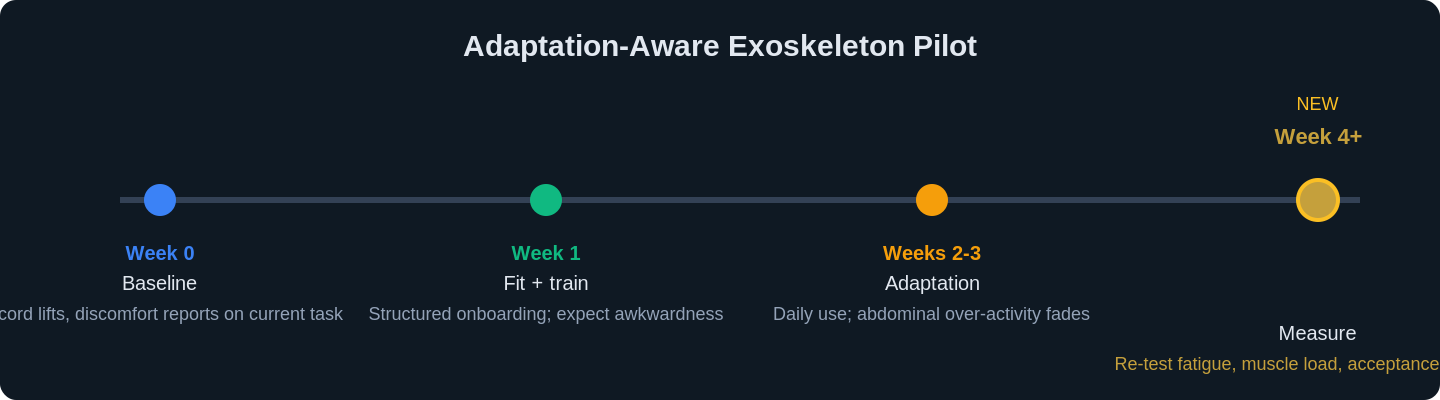
- Abdominal activity was temporarily elevated during first uses — the body stabilizing around an unfamiliar device — then faded after several days
- The researchers interpret the pattern as motor adaptation: genuine learning, not an instant mechanical effect
Why this kills the one-day demo
Those first days of elevated abdominal activity are the tell. Workers are actively re-learning how to move — exactly like breaking in new technique, not slipping on a new tool. Evaluate on day one and you measure the awkwardness of learning. Evaluate after adaptation and you measure the benefit. Both readings are real; only the second one predicts what six months of use will look like.
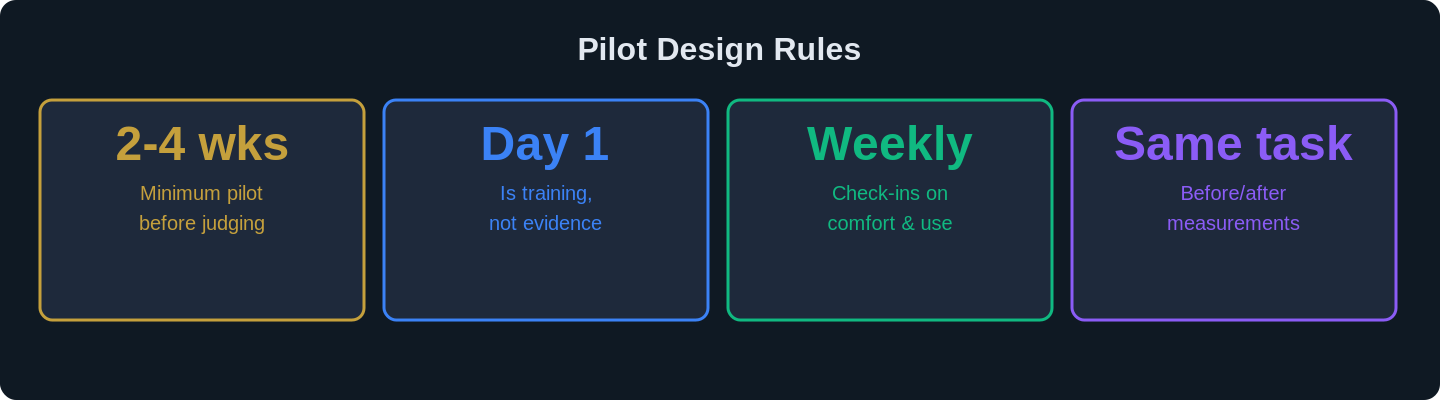
First-day exoskeleton assessments may miss the eventual benefit — or the eventual problems — because users' movement strategies change over time. That has practical implications for training, pilot duration, worker acceptance, and procurement evaluations.
A better pilot playbook
If you're evaluating any lumbar-support device, build the adaptation curve into the plan:
The takeaway
Budget pilots in weeks, not hours — and write the adaptation period into the evaluation criteria so nobody kills a program on day-one awkwardness. If a vendor insists the full benefit is instant and measurable in a one-hour demo, ask them how their device accounts for motor adaptation. In this new research, that question separates the evidence-based suppliers from the brochure sellers.
Sources: Corset Saint-Francis / Université Laval; Exoskeleton Report