
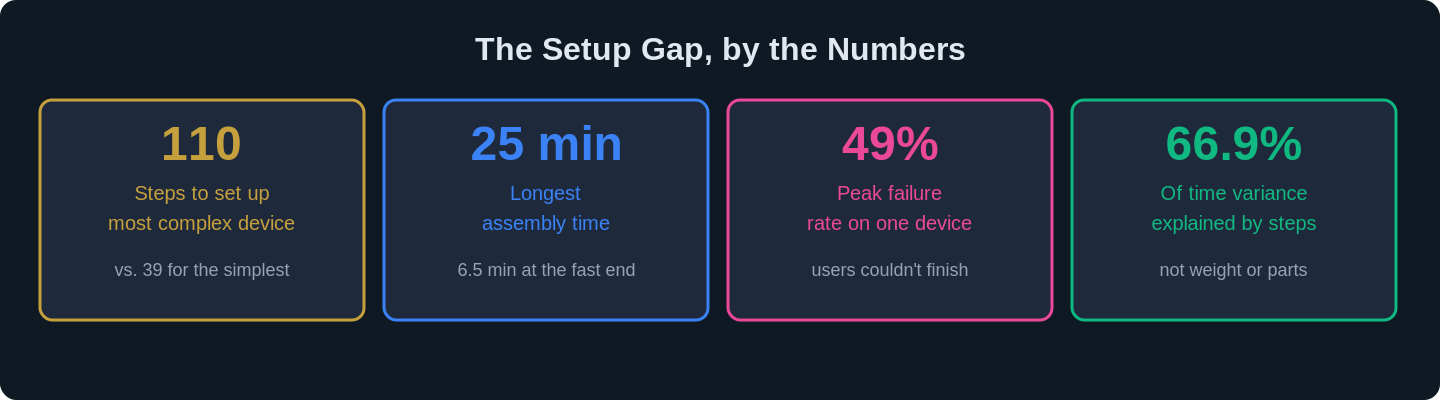
Here's an uncomfortable number for anyone running an exoskeleton pilot: 110 steps. That's how many discrete actions it took one group of test users to assemble the most complex of four occupational exoskeletons evaluated in a new peer-reviewed study published in PLOS One by engineers at the University of Texas at El Paso. The simplest device still needed 39. If your safety program is betting on wearable robotics to cut musculoskeletal injuries, this research suggests the thing most likely to sink your rollout isn't the device's biomechanics — it's whether a worker can get it on before the shift starts.
What the study actually measured
Most exoskeleton research measures what happens during use — muscle load, fatigue, injury rates. The UTEP team asked a different, largely ignored question: what happens before and after? Twenty-nine engineering students each assembled, donned, doffed, and disassembled four real-market devices (the Ironhand grip glove, the Chairless Chair sit-stand support, the Skelex shoulder frame, and the Laevo back unit), generating 397 timed observations. The researchers logged every procedural step, every usability problem, and every failure.
The counterintuitive finding buyers need to hear
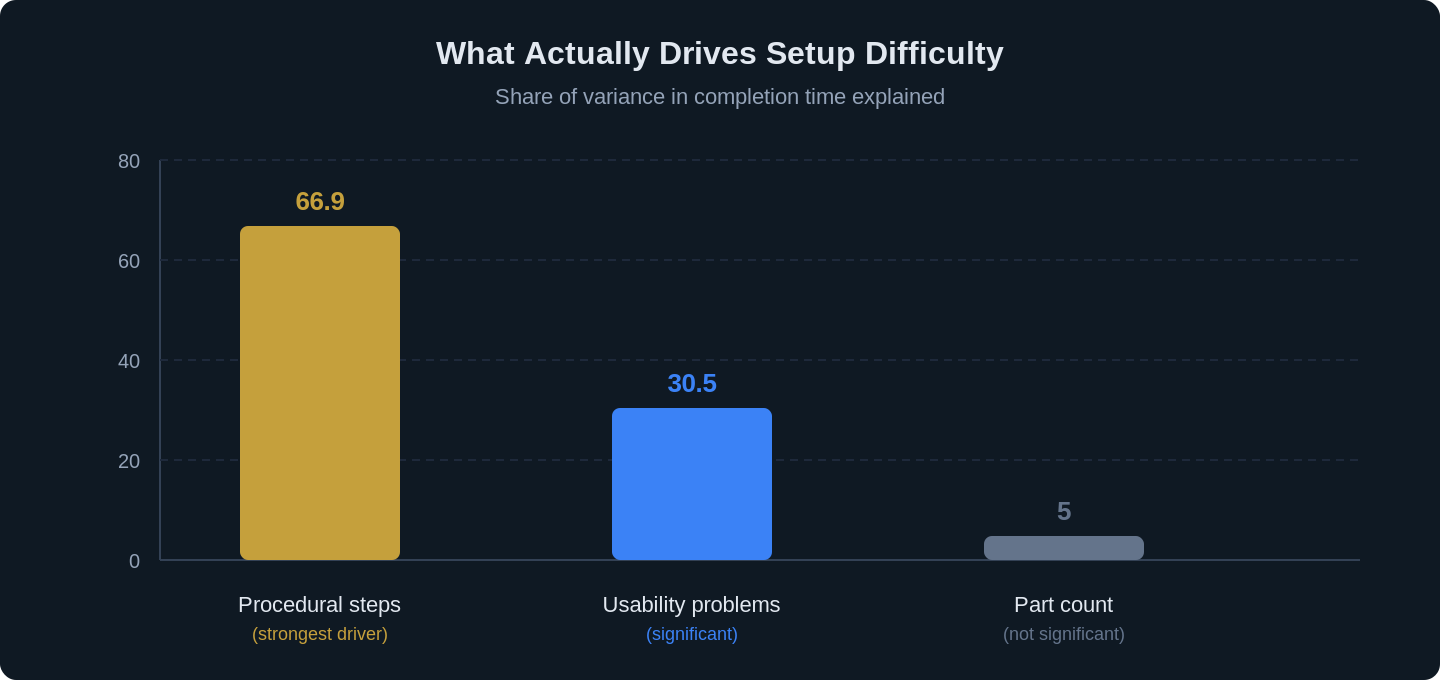
The single strongest predictor of setup time was the number of procedural steps — accounting for 66.9% of the variance in completion times, with each additional step adding roughly 22 seconds. Usability problems (unclear instructions, two-person operations, fiddly connection points) were the second driver. But here's the part that should change how procurement teams score devices: part count had no significant relationship with difficulty at all. A device with fewer pieces is not automatically easier to deploy. What matters is how those pieces come together.
A device that's helpful to wear from a biomechanics standpoint is useless if it takes half an hour to assemble or needs a second person to put on.
So what: a 5-point checklist for your next evaluation
The researchers distilled their findings into a practical design brief that doubles as a buyer's scorecard. Before you commit to a vendor, put a real worker — not an engineer — through a timed setup and grade the device on these five points:
- One-person operation: can a single worker don and doff it unaided?
- No special tools: does setup require hex keys, tape measures, or calibration jigs?
- Fewer steps, not fewer parts: count the actions, not the components.
- Self-aligning connections: do parts snap into the right position, or require fiddling?
- Clear confirmation: is there an obvious 'you got it right' signal at each step?
The study's one caveat: it ran in a lab with students and no time pressure. As lead author Jessica Sanchez-Balandran noted, the next step is testing "under real-world conditions — actual workers, time pressure, busy environments, and repeated use across a full shift, where setup time really starts to cost money." That's exactly the environment your EHS team should simulate before signing a purchase order. The biomechanics may be proven — but if the donning process fails your floor test, the ROI never materializes.
Sources: PLOS One (Sanchez-Balandran et al., 2026); UTEP News