
Case Study | 2026-06-30
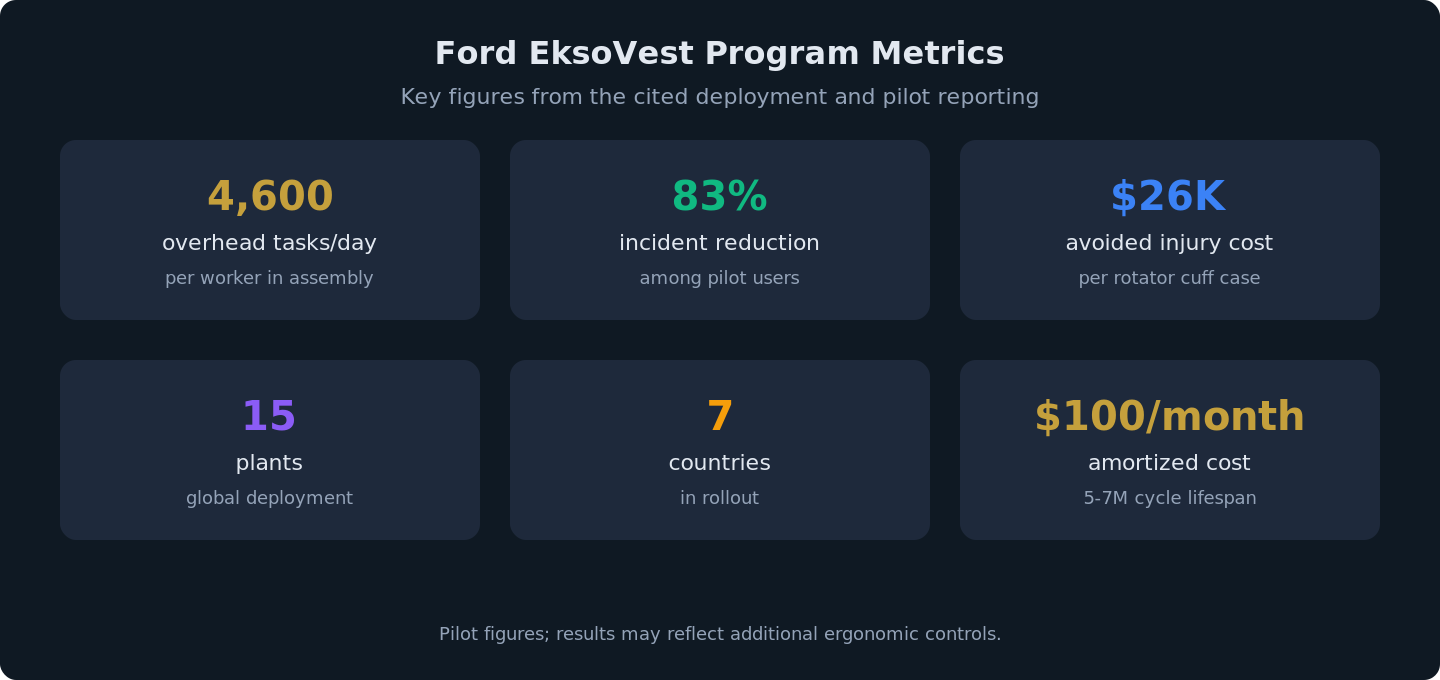
The Case: Ford Motor Company deployed the EksoVest across 15 plants in 7 countries for overhead assembly tasks, according to Ford Media Center. In the pilot, 83% fewer incidents were reported among users, according to EHS Today. The program offers a practical test of exoskeletons, not a universal guarantee.
The Challenge: 4,600 Overhead Tasks a Day
Ford assembly workers performed about 4,600 overhead tasks per day, according to Ford Media Center. Repetitive overhead work stresses the shoulders and rotator cuff. EHS Today cites $26,000 as the cost per rotator cuff injury avoided, giving safety teams a concrete benchmark for evaluating prevention.
The Intervention: Clear Cost Signals
Ford's pilot used the EksoVest for overhead assembly tasks. Gigazine reports the device cost at about $100 per month when amortized and a lifespan of 5 million to 7 million cycles. For procurement teams, those figures make the vest comparable to other recurring safety investments.
The Results: Strong Signals, Not Proof of Causation
The pilot was UAW-funded, according to EHS Today, which also reports an 83% incident reduction among EksoVest users. Gigazine reports the same 83% accident reduction. Ford Media Center says Ford deployed the technology across 15 plants in 7 countries.
These numbers are compelling, but they do not isolate the vest from every other variable. Pilots can coincide with task rotation, training, line adjustments, and heightened safety attention. The practical lesson is not that exoskeletons always produce an 83% drop, but that Ford found enough value to expand the program.
What Safety Leaders Should Take From This
MarketIntelo estimates that automotive and manufacturing represent 34.5% of the industrial exoskeleton market. It also reports musculoskeletal disorder reductions of 40% to 65% and annual savings of $8,000 to $22,000 per worker. Ford's case is narrower than those market estimates, but it shows a repeatable evaluation path: identify high-exposure tasks, estimate avoided-injury value, run a pilot, and track incident data before scaling.
For teams evaluating similar devices, the Ford example supports three checks: confirm the task exposure, compare amortized device cost with avoided-injury estimates, and require pilot incident data against a baseline before wider capital spending. This keeps the decision tied to operations, not enthusiasm.
Lesson for Safety Leaders: Ford's case shows how to pilot exoskeletons cautiously. Start with a high-risk overhead task, compare device cost with avoided-injury estimates, require baseline incident data, and treat the 83% reduction as a promising signal rather than a guaranteed result.