
Implementation | 2026-06-30
🎯 The Question: You have heard about exoskeletons. Your operations team wants to try them. Where do you actually start? This guide walks through the practical steps — from identifying the right tasks to measuring program ROI.
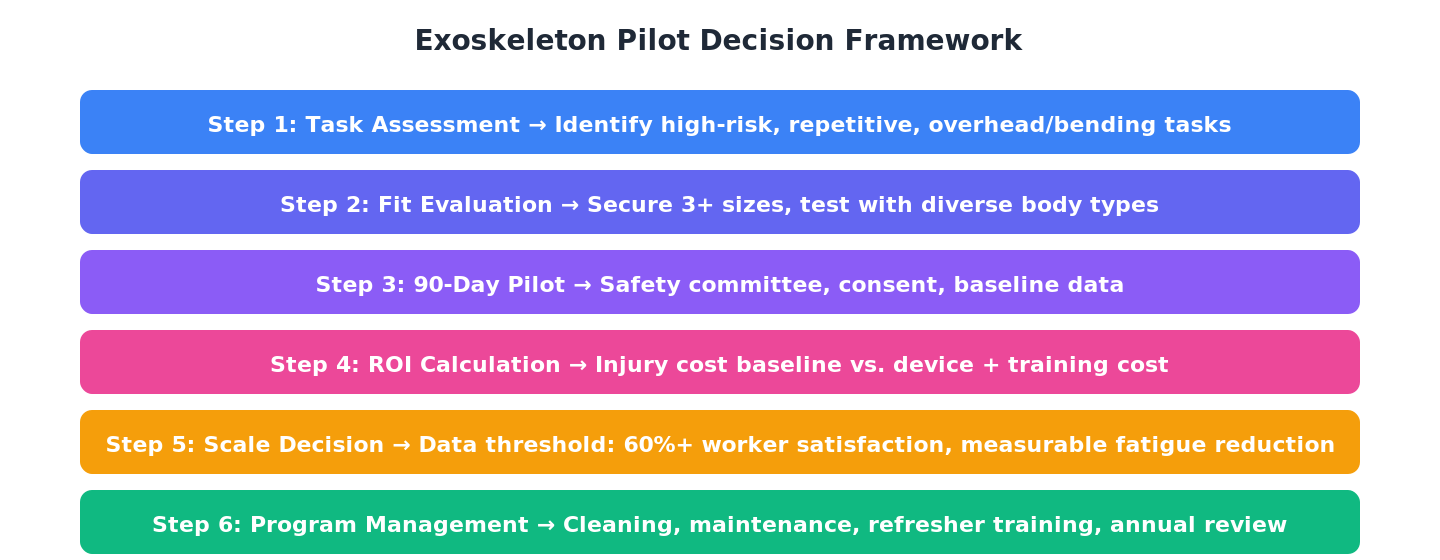
Step 1: Task Assessment — Finding the Right Fit
Not every task is suitable for an exoskeleton. The best candidates share common characteristics: repetitive overhead work (assembly, welding, painting), repeated bending or stooping (material handling, palletizing), or static crouching/kneeling (underbody work, maintenance). Passive exoskeletons work best for tasks that involve sustained postures or repetitive movements. Powered exoskeletons suit tasks requiring active lifting assistance of 15+ pounds.
Common mistake: Assuming one exoskeleton type works for all tasks. Upper-body support vests help with overhead work but offer zero back support during lifting. Task-exoskeleton matching is essential.
Step 2: Fit Evaluation — One Size Does Not Fit All
Fit is the single most important predictor of worker adoption. Most exoskeleton manufacturers offer multiple sizes or extensive adjustability. When trialing, secure at least 3 different sizes to test with your workforce's full anthropometric range — from the shortest to the tallest to the broadest workers. A device that doesn't fit will be uncomfortable at best and harmful at worst.
Ford's EksoVest, for example, fits workers from 5 feet 2 inches to 6 feet 4 inches. Even with that range, they tailored individual units to specific workers and did not share devices across shifts.
Step 3: Run a 90-Day Pilot
A meaningful pilot needs three elements: (1) A defined high-risk task area, (2) A willing participant group (5-10 workers), and (3) Baseline data on fatigue, discomfort, and productivity. Engage your Health and Safety Committee from day one. Collect objective feedback weekly using a standardized discomfort survey (such as the Cornell Musculoskeletal Discomfort Questionnaire).
Worker acceptance is not guaranteed. Some workers may feel self-conscious or worry about looking less capable. Address these concerns upfront with peer testimonials and education sessions.
Step 4: Calculate the Real ROI
The economics are straightforward. Field studies across automotive and logistics deployments document MSD injury rate reductions of 40-65%, with average annual savings of $8,000 to $22,000 per protected worker. For passive back-support exoskeletons priced at $2,000-$5,000 per unit, payback periods of 6-18 months are commonly achieved. For powered systems, ROI timelines extend to 18-36 months.
Your calculation should include: avoided direct medical costs, avoided indirect costs (3-5x direct), productivity improvements, reduction in ergonomic risk scoring, and worker retention improvement. The HeroWear Apex study documented a payback of under 6 months and a 13x ROI over 5 years.
Step 5: Scale Based on Data, Not Hype
Set clear thresholds before scaling: (1) ≥60% worker satisfaction score in the pilot group, (2) statistically significant reduction in discomfort scores, (3) measurable productivity or quality improvement, and (4) acceptable payback period. If any threshold is not met, investigate root causes before expanding.
Step 6: Program Management
Once scaled, treat exoskeletons like any other PPE or tool. Establish cleaning protocols (some devices get sweaty and need daily wipe-downs), replacement schedules (5-7 million cycles for passive units), and refresher training. Track usage data and injury trends to validate ongoing ROI. Most importantly, maintain an open feedback loop with workers — they will tell you what is working and what isn't.
✅ Checklist for Success: ☐ Task matched to exoskeleton type ☐ Multiple sizes trialed ☐ Worker consent and safety committee buy-in ☐ Baseline and post-pilot data collected ☐ Payback period calculated ☐ Cleaning and maintenance schedule established ☐ Annual program review planned
💡 Want to Learn More?
Next Reality Robotics helps organizations evaluate, pilot, and deploy workplace exoskeleton solutions. Subscribe to The Workplace Ergonomics Brief for weekly insights delivered to your inbox.