
Powered exosuits have crossed the threshold from innovation experiment to standard safety equipment. With HexArmor/uvex now distributing Verve Motion's SafeLift exosuit and IAG trialing it on baggage handlers, the question for EHS and operations leaders is no longer 'does this technology work?' — it is 'how do we evaluate it for our workforce without wasting six months on a feasibility study?' The answer is a focused 30-day pilot designed to produce one clear decision: scale it, adjust it, or shelve it.
Step 1: Pick Your Highest-Strain Task, Not Your Biggest Department
The most common mistake is deploying an exosuit across an entire warehouse or production line. That produces noisy data and dilutes the signal. Instead, identify the single manual-handling task with the highest ergonomic risk score — the job where workers report the most fatigue, where injury claims cluster, or where turnover is highest. A baggage handler lifting 50-pound bags into aircraft holds is a textbook example: high repetition, heavy load, awkward posture, all shift. Start there. One task, one crew, one month.
Step 2: Measure Acceptance First, Injuries Second
Injury reduction is the ultimate goal, but 30 days is too short to measure a statistically meaningful change in injury rates. The leading indicator that predicts long-term success is worker acceptance: will your team actually wear the device for a full shift, voluntarily, without being told to? Track daily wear time, comfort ratings (simple 1-5 scale), and unsolicited feedback. If workers are taking the exosuit off after two hours, no amount of biomechanical data will save the program. According to FSM Magazine, SafeLift's soft, flexible design lets workers bend, twist, and move naturally — which is exactly the kind of all-day comfort that drives acceptance.
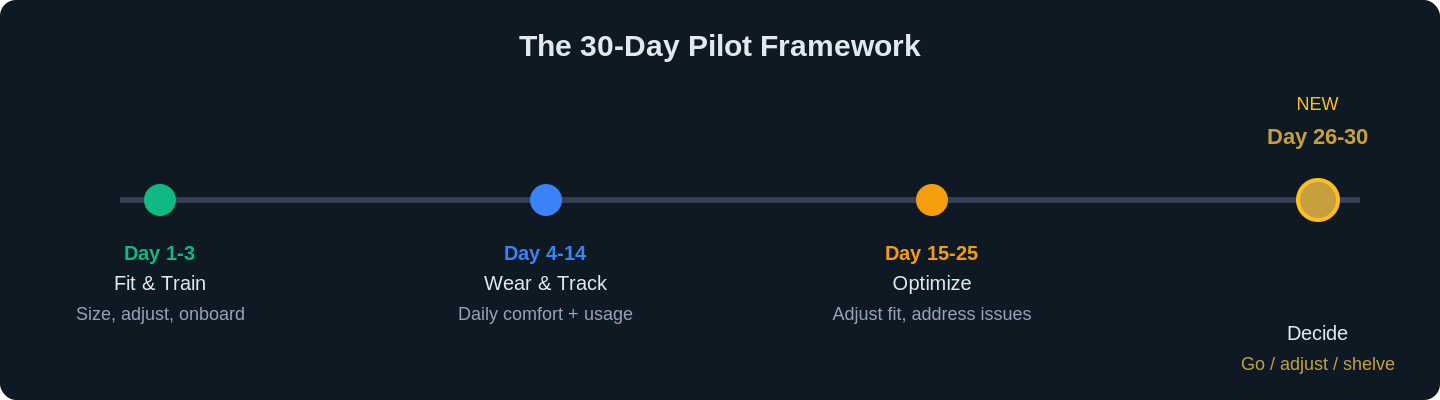
Step 3: Define Your Go/No-Go Criteria Before You Start
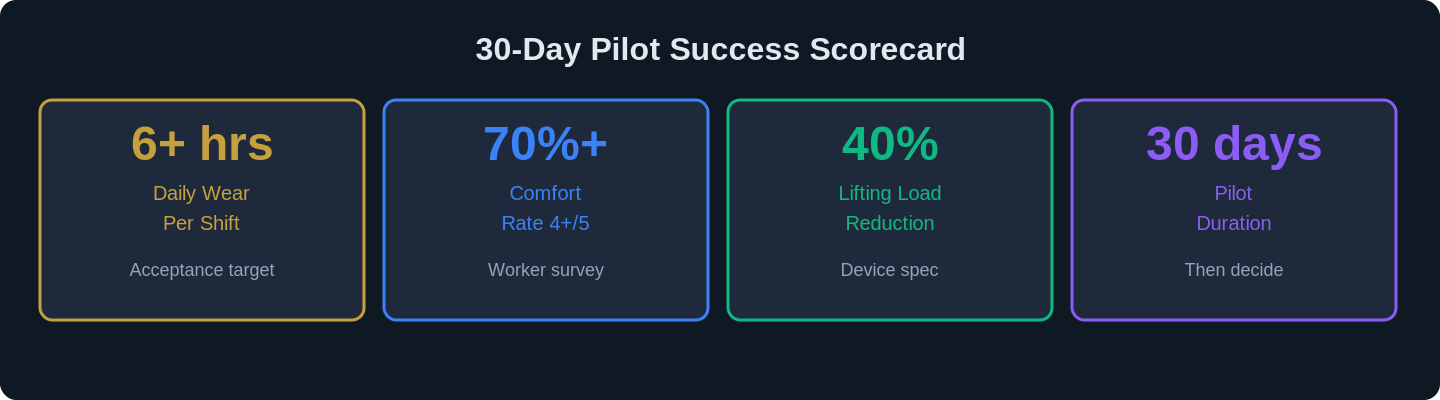
Decide what success looks like on Day 1, not Day 30. A simple scorecard works:
- Acceptance: Average daily wear time exceeds 6 hours per shift, and 70%+ of workers rate comfort 4 or higher.
- Strain reduction: Workers report measurable reduction in end-of-shift fatigue (survey-based, not just biomechanical).
- Operational fit: No measurable slowdown in task throughput; supervisors report no new safety concerns.
- Cost clarity: You have a per-worker annual cost estimate including device, training, servicing, and replacement.
Step 4: Budget for the Full Lifecycle, Not Just the Device
Exosuits are now distributed through standard PPE channels, which means they need the same infrastructure as any safety equipment: fit-testing, cleaning, maintenance, and replacement. ISHN notes that SafeLift uses motion sensors and a small motor to reduce lifting load by up to 40% — that motor and sensor system will need servicing. Build a per-worker annual cost that includes the device amortization, training time, cleaning supplies, and a servicing contract. Then compare it against your current per-worker cost of overexertion injuries: workers' comp claims, lost productivity, and turnover.
The Takeaway
You do not need a six-month study to know whether powered exosuits fit your operation. Pick your highest-strain task, put a current-generation soft exosuit on a small crew for 30 days, measure acceptance and comfort, and let the data make the decision. The technology is mature enough that British Airways' owner is trialing it on the ramp and a global PPE leader is distributing it. The only question left is whether your team will wear it — and a 30-day pilot is the fastest way to find out.
Sources: Verve Motion (press release); ISHN; Aviation Pros; FSM Magazine