
Baggage handling is one of the most punishing jobs in commercial aviation — thousands of lifts per shift, awkward postures, and a relentless pace. Now International Airlines Group (IAG), the parent of British Airways, Iberia, and Aer Lingus, is investing in wearable robotics company Verve Motion to test powered exosuits that take the strain out of lifting bags and cargo. For EHS and operations leaders, it is a landmark signal: if one of the world's largest airline groups is betting on exosuits for its frontline crews, the technology has crossed from pilot-project curiosity to serious injury-prevention infrastructure.
What IAG Is Actually Doing
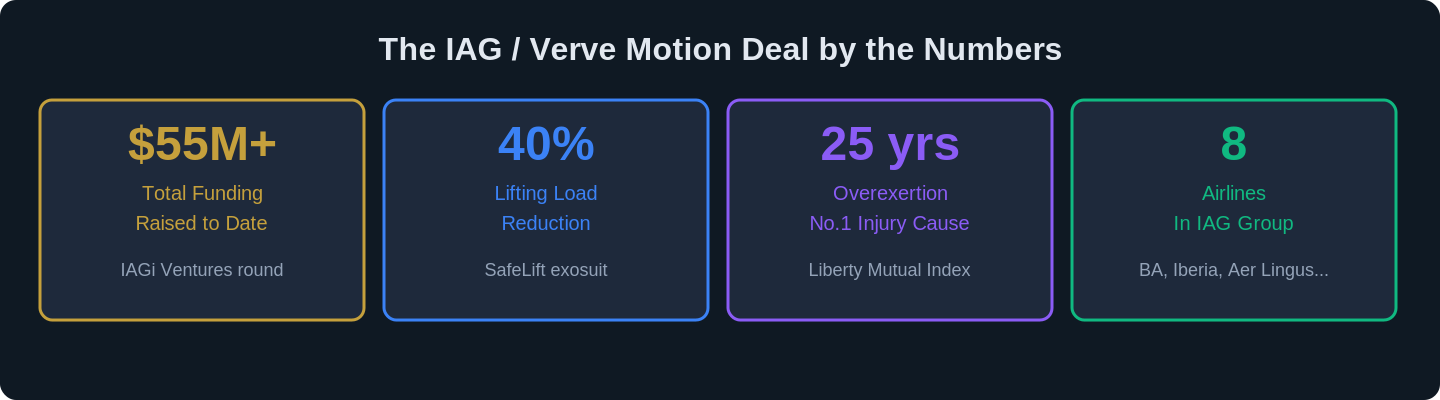
Through its venture arm IAGi Ventures, IAG joined a funding round — alongside PPE manufacturer HexArmor and other investors — that lifts Verve Motion's total raise above $55 million. The partnership is not a passive investment. IAG will work with Verve Motion to trial a shoulder-support exosuit built specifically for aviation ground operations, starting with baggage handlers, to measure whether it improves worker comfort, cuts repetitive lifting strain, and supports more efficient baggage and cargo handling.
Verve Motion is exactly the kind of company we want to back through IAGi Ventures — a business applying innovative technology to solve real operational challenges. This partnership gives us the opportunity to test and shape the technology in a live operating environment while helping improve the day-to-day experience of colleagues carrying out physically demanding work.
The Business Case: A $13 Billion Problem
The numbers explain why a major airline group is moving. According to the Bureau of Labor Statistics data cited by ISHN, musculoskeletal disorders — sprains, strains, and back injuries from repetitive lifting — account for nearly one-third of all serious workplace injuries. The Liberty Mutual 2025 Workplace Safety Index puts the cost to U.S. businesses at more than $13 billion annually and ranks overexertion as the No. 1 cause of serious, nonfatal workplace injury for 25 consecutive years. Verve Motion's SafeLift exosuit, born from Harvard University research, uses motion sensors to detect a lift and a small motor to assist the lower back — reducing the physical load of every lifting or lowering motion by up to 40%.
Why This Matters Beyond Aviation
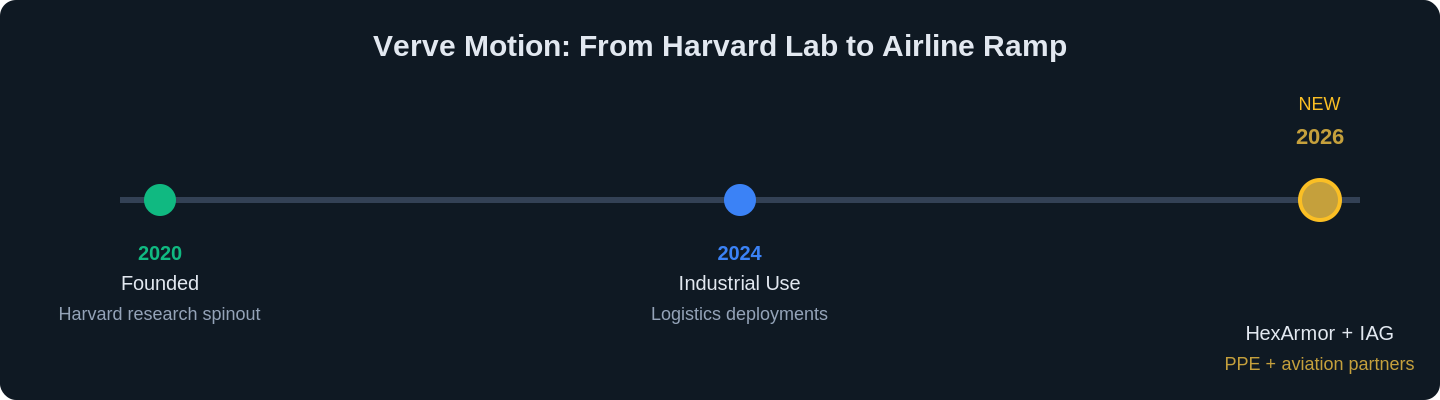
Founded in 2020 by Spanish entrepreneur Ignacio Galiana, Verve Motion already deploys its exosuits in logistics and industrial settings. The IAG trial matters because aviation ground operations are a worst-case ergonomic environment — high repetition, heavy loads, tight turnaround times. If wearable robotics can reduce injuries there, the case for warehouses, distribution centers, manufacturing lines, and construction sites becomes even stronger. The simultaneous entry of HexArmor — a global PPE leader — as a distribution partner signals that exosuits are moving out of the robotics lab and onto the standard safety-equipment procurement list.
The Takeaway for Operations Leaders
You do not need to run an airline to read the writing on the wall. When a global aviation group and a PPE giant both put money behind powered exosuits in the same week, the technology has reached a maturity threshold worth evaluating for any role involving repetitive lifting. Start by identifying your highest-strain manual-handling task, then run a focused 30-day pilot that measures worker comfort, fatigue, and injury rates — not just whether the device works, but whether your team will actually wear it all shift.
Sources: Aviation Pros; Verve Motion (press release); ISHN