
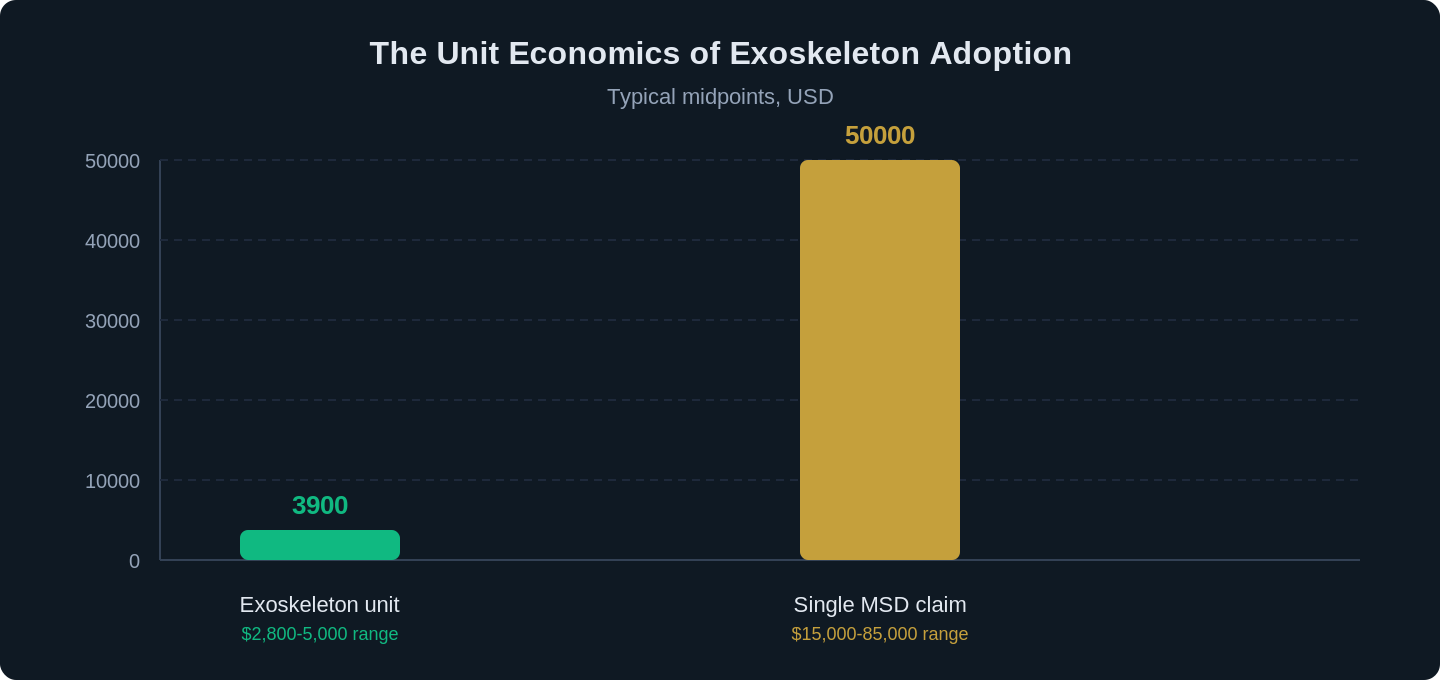
Safety directors have wanted exoskeletons for a decade. Finance directors only recently said yes. According to a new analysis in Global Brands Magazine, industrial exoskeletons have crossed from pilot projects into standard kit — because the numbers finally stopped being theoretical. A unit costs $2,800 to $5,000, while a single musculoskeletal disorder claim runs $15,000 to $85,000.
The arithmetic that changed procurement
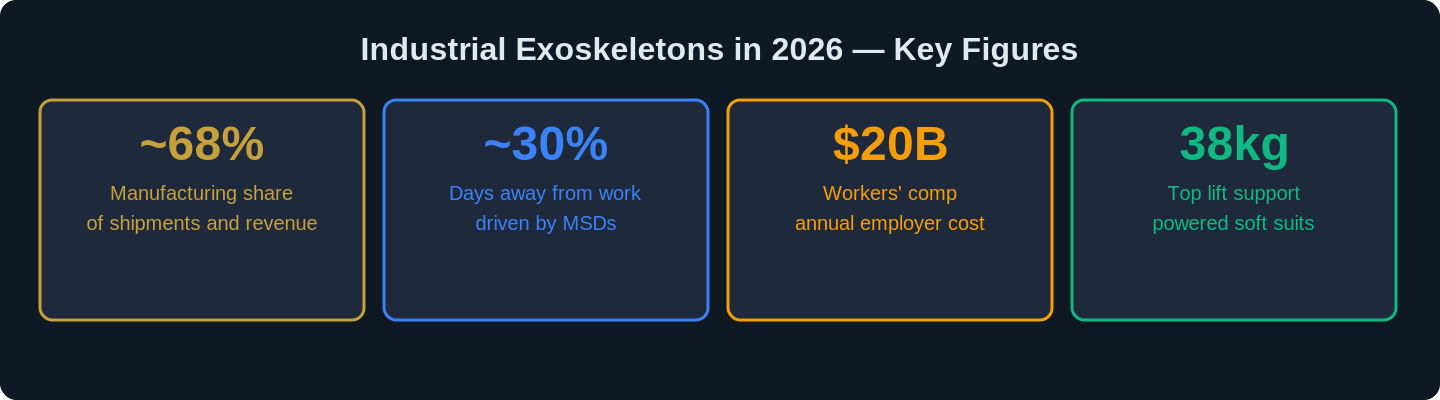
Musculoskeletal disorders account for over a million workplace injuries a year in the United States and roughly 30% of days away from work, with employer workers'-compensation costs commonly put around $20 billion; NIOSH has estimated the wider annual burden at $13 billion to $54 billion once indirect costs are counted. One avoided claim can pay for a small fleet of exoskeletons — which is why procurement teams that used to file this under innovation now file it under personal protective equipment.
What buyers are actually purchasing
Passive frames still dominate on price and simplicity — no batteries, no software, almost no maintenance — but powered soft exosuits are winning the comfort argument that decides whether workers keep the kit on for eight hours. German Bionic's Exia, shown at CES 2026, offers up to 38 kg of dynamic lift support plus walking assistance, and the company has started cutting vests specifically for women. That sounds like a footnote and is not: fit is the single biggest reason wearable kit gets left in a locker. Research is starting to catch up with the sales pitch — a 2026 study found that pairing wearable support with a robotic assist arm cut lifting strain on factory workers by as much as 65%.
The buyer's checklist
- Will people wear it? Comfort and fit beat peak force every time.
- How long does donning take? Two minutes at shift start is fine; six is not.
- Does it hinder any part of the job — climbing, crouching, driving a truck?
- What does hygiene and shared-use cleaning look like across three shifts?
- Can motion data be used to improve station design rather than monitor individuals?
That last point is the one that decides whether a rollout succeeds. Suits that log motion can flag the workstation causing the trouble — used well, that is ergonomics. Used badly, it feels like surveillance and the programme dies.
Three signals to watch next: insurers pricing wearable support into premiums, clearer testing and certification standards, and rental or subscription models that suit peak-season logistics better than outright purchase. Exoskeletons are now a line on the safety budget, sitting between gloves and forklifts — and that unglamorous status is exactly what mass adoption looks like.
Sources: Global Brands Magazine