
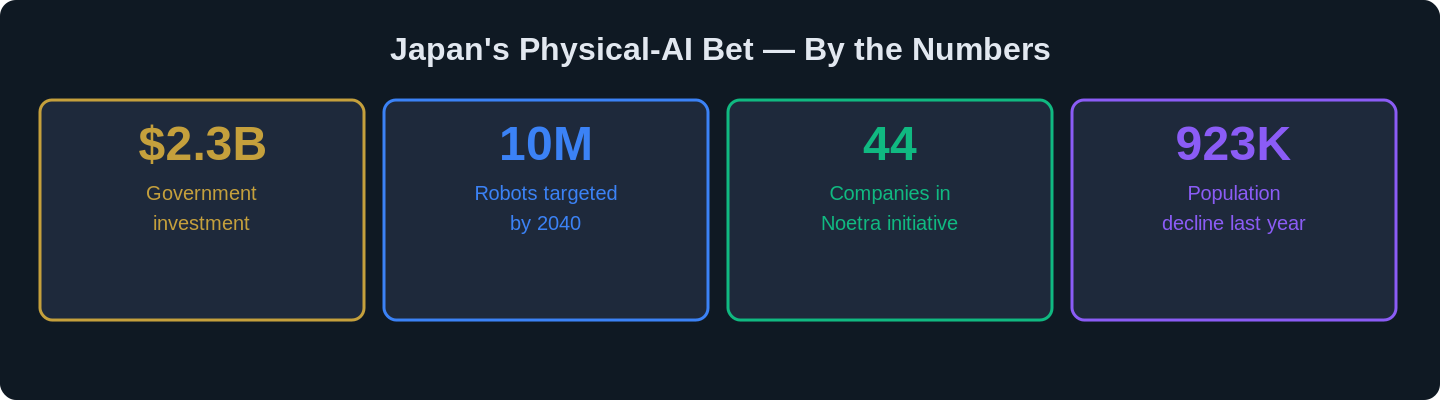
Here's what a labor shortage looks like when it becomes national policy: the Japanese government announced in June it will invest the equivalent of $2.3 billion in 'physical AI' — and its stated goal is to put 10 million humanoid robots to work by 2040. If you lead operations, safety or HR in any labor-intensive industry, this is your preview of where workforce strategy is heading.
The shape of the bet
HR Brew reports that 44 companies — including SoftBank, NEC and Fujitsu — are now participating in a nationwide physical-AI initiative led by government-funded tech firm Noetra to develop AI systems that power robots and other machines. The funding, reported by The Japan Times, is aimed squarely at industries where the talent gap is widest: eldercare, healthcare, food manufacturing and logistics, according to Tom's Guide.
It's not only hardware. At SusHi Tech Tokyo 2026, employers debuted 'AI employees' with their own email addresses and job descriptions that take on recurring tasks. Kuse's AI worker 'Junior' already holds full-time roles at companies, onboarded like a human hire.
Augmentation, not replacement
The rhetoric from the companies involved is remarkably consistent with the ergonomics industry's own playbook. The physical-AI push is framed around keeping humans in the loop for dangerous, repetitive physical work — not eliminating the workforce.
For years, the AI conversation has focused on how technology can improve knowledge work. The next challenge is how AI can help people perform physical work more safely, consistently and productively. Physical AI is about augmenting people, not replacing them.
Why this matters outside Japan
Japan is simply the oldest, most labor-scarce version of a problem every industrial economy shares. When a G7 government prices the solution at billions and names eldercare, food manufacturing and logistics as the targets, it validates exactly what EHS and operations teams have argued for years: physical work is the bottleneck, and technology that keeps people capable — exoskeletons, assist suits, cobots, physical AI — is becoming infrastructure, not experiment.
- Budget signal: national-scale money de-risks adoption decisions for plant-level buyers
- Tech pipeline: 44-company initiative means faster cost curves for sensing, actuators and control
- Retention signal: augmentation framing is the politically durable path — expect it in your own vendor pitches
- Timeline signal: 2040 is the destination, but pilots are funded now
The takeaway
Don't wait for humanoid robots to appear on your floor to act. The same demographic math driving Japan's $2.3 billion bet is already shrinking your applicant pool. Audit your highest-strain physical tasks today, pilot augmentation where the exposure is worst, and build the internal expertise now — because when the hardware gets cheap, the winners will be the companies that already know how to integrate it.
Sources: HR Brew; The Japan Times; Tom's Guide (Yahoo Tech); IT Brief Australia