
Cargo handlers don't get hurt by one heavy box. They get hurt by ten thousand light ones. That cumulative-strain logic is exactly why Maastricht Aachen Airport has become the first airport in the Netherlands to deploy an AI-powered exoskeleton in daily cargo operations — a milestone that turns airport ground handling into the newest beachhead for industrial wearable robotics.
What's actually being deployed
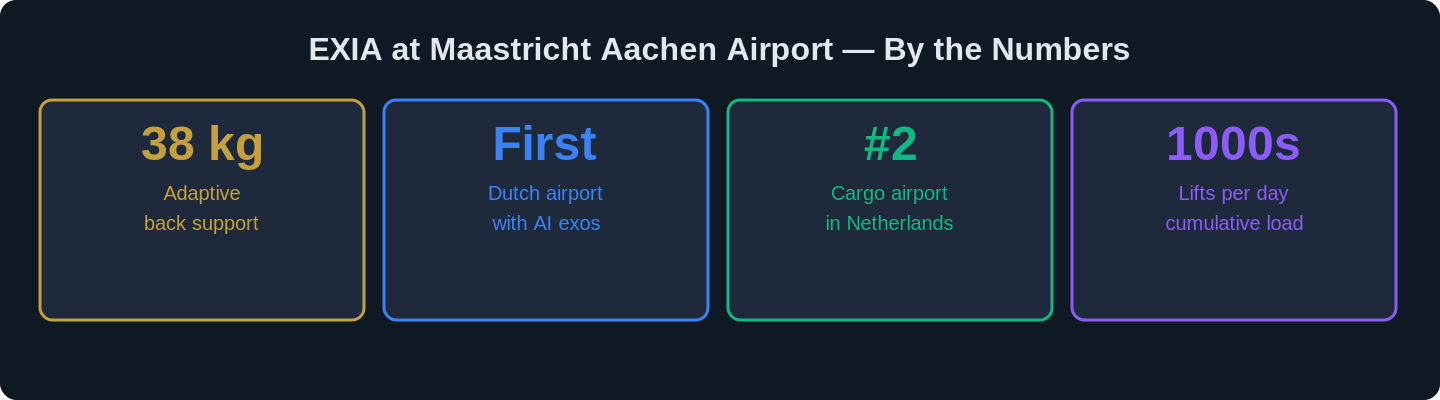
The airport's ground handling teams now work with the EXIA exoskeleton from German Bionic. Unlike passive braces, EXIA uses AI-powered sensors to analyze each lifting movement in real time and deliver active back support precisely when a lift demands it — adaptive assistance of up to 38 kilograms, while still letting workers move naturally on the apron and inside the cargo warehouse.
Maastricht Aachen is the Netherlands' second-largest cargo airport, which matters for two reasons: the volume of freight makes the ergonomic exposure real, and a deployment at this scale becomes a reference case for every ramp, warehouse and distribution center watching from the sidelines. Air Cargo News reports the airport is framing the technology as part of a wider strategy of practical innovation aimed at operational efficiency and future-ready cargo operations.
For us, innovation is about making work safer, healthier and more enjoyable for our people. With EXIA, we are investing not only in advanced technology, but above all in the people whose commitment keeps our operation moving every day.
Why cargo handlers went first
Note the airport's own framing: the injury risk is not the weight of any individual shipment, but the cumulative effect of thousands of lifting and handling movements across a shift. That is the exact failure mode exoskeletons are built to address — they don't replace muscle, they bleed off repetitive load before it becomes a disc, a claim, or a vacancy.
- AI-triggered support — assistance activates when the sensors detect a lift, so workers aren't fighting the device between tasks
- Up to 38 kg adaptive assist — meaningful lumbar offloading for real cargo weights
- Employability framing — the airport ties the technology to keeping experienced handlers healthy and working longer
- Daily-operation use — this is not a trade-show demo; EXIA is in the daily cargo rotation
The takeaway for ops and EHS leaders
If you run lifting-intensive operations — logistics, baggage, parcel, food production — the lesson is not 'buy EXIA.' It's that airport-grade operations are now treating exoskeletons as standard equipment for cumulative-strain risk, the same way you'd treat anti-fatigue matting or lift-assist devices. Start where Maastricht started: quantify the repetitive lifts per shift, identify the highest-exposure crews, and pilot a powered assist on one team. Six months from now you'll have the same thing this airport just got — a first-mover reference case of your own.
Sources: Air Cargo Week; Air Cargo News; German Bionic