
A Data-Driven Look at the Coming Talent Crunch — and Why Worker Augmentation Isn't Optional Anymore
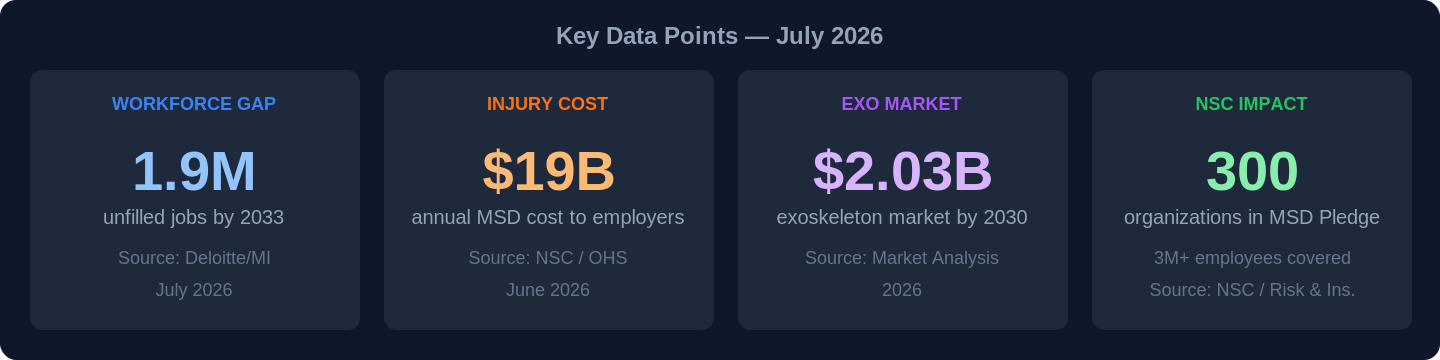
The numbers are stark and getting starker. By 2033, U.S. manufacturers will need 3.8 million additional workers — and nearly half of those jobs — 1.9 million — could go unfilled, according to a landmark July 2026 study from Deloitte and The Manufacturing Institute. This isn't a prediction in some distant future. The gap is already visible, and it's reshaping how plant managers, safety directors, and HR leaders think about their workforce.
The Workforce Math Doesn't Add Up
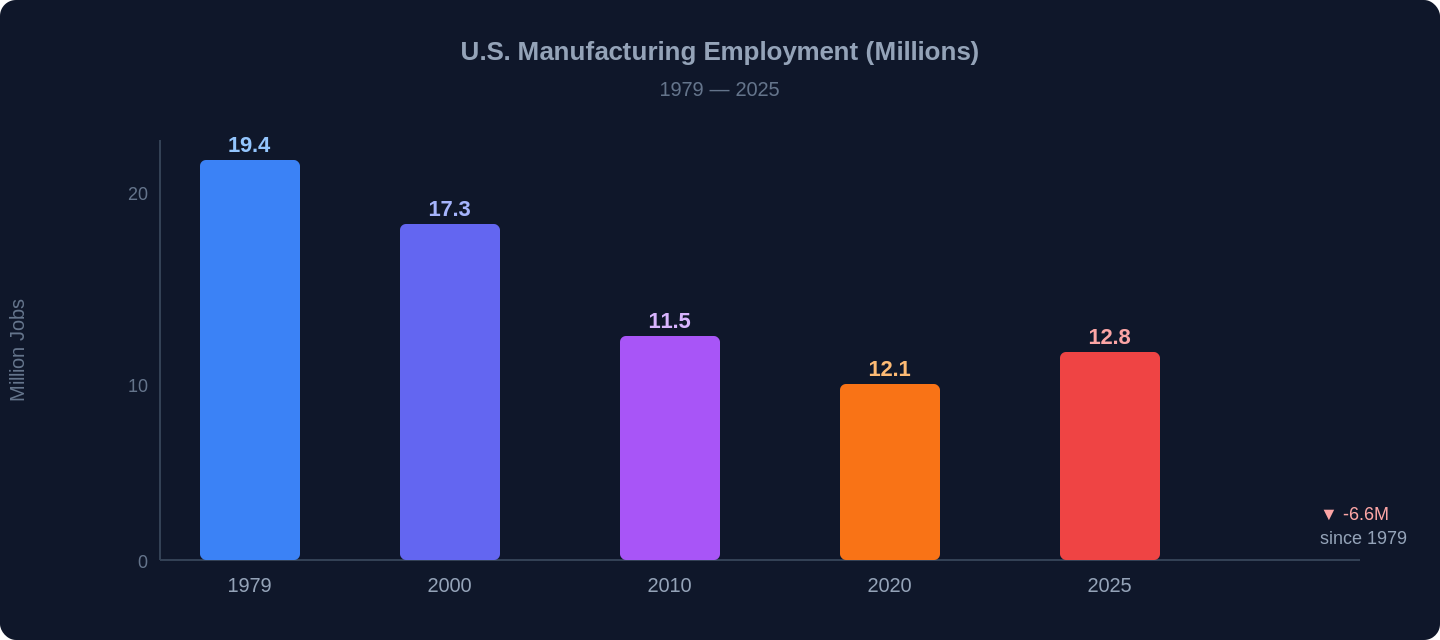
To understand why, consider the trajectory. Total U.S. employment grew by 68 million between 1979 and 2025. Over the same period, manufacturing employment fell by 6.6 million. Factory jobs peaked at 19.4 million in 1979 and currently sit near 12.8 million — a level not seen since before World War II, adjusted for population growth. The work didn't vanish — it moved offshore, and the hiring pool drained long before reshoring began reversing the flow.
Now reshoring is accelerating the crisis. Companies announced 244,000 reshoring and foreign-investment jobs in 2024 alone, the Reshoring Initiative reports. Of those, 88 percent were in high or medium-high tech sectors — electronics, EV batteries, semiconductors — demanding skilled labor that's already in critically short supply. More than 2 million such jobs have been announced since 2010, and every new plant competes for the same shrinking pool of engineers, technicians, and machinists.
Not Sci-Fi, Straightforward Shortage
In the same week the Deloitte study landed, a surprising coalition announced its response. BlackRock, Carhartt, Ford, and Google jointly launched the Alliance for America's Skilled Trades — a workforce initiative aimed at expanding apprenticeship programs and promoting pathways into electrical, technical, and building trades. "Investment in America's infrastructure will help shape the country's long-term economic trajectory, but its success ultimately depends on the skilled workforce that brings these projects to life," said Bayo Ogunlesi, BlackRock's chairman.
The coalition — spanning Wall Street, manufacturing, retail, and tech — signals a rare consensus: the labor shortage is structural, not cyclical. It won't fix itself. And for safety and operations leaders, it creates a double bind. Fewer workers means fewer applicants — but also means the workers you do have are more valuable and harder to replace. Every injury that sidelines an experienced operator now carries a higher cost than ever.
What About the Robots?
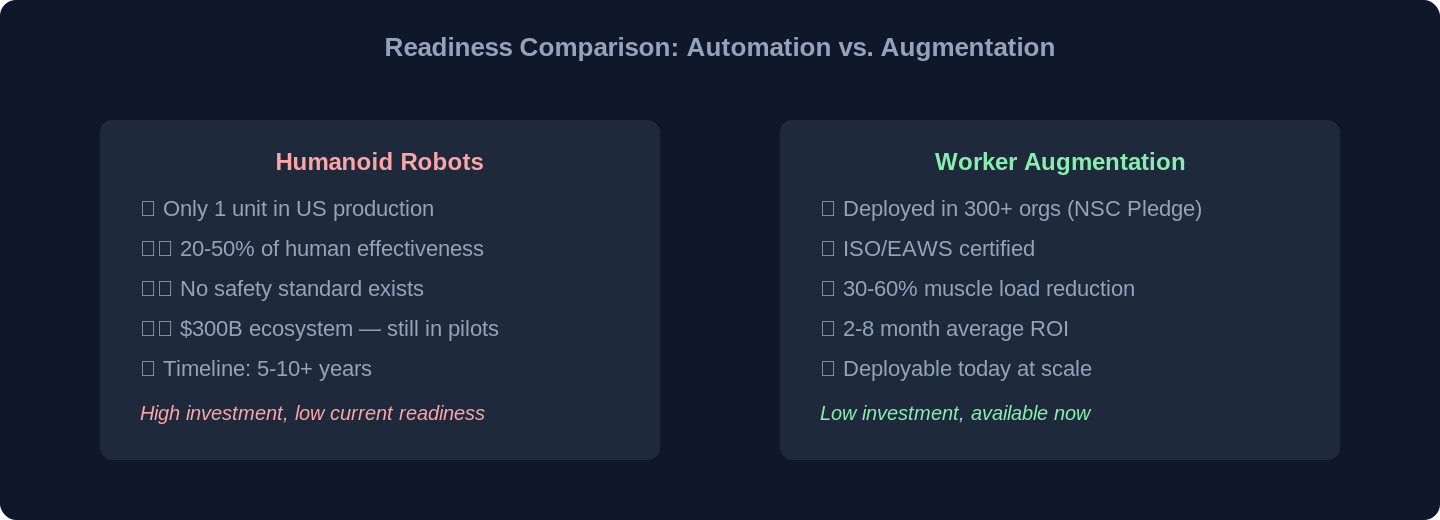
A natural question: if we're short millions of workers, won't automation simply fill the gap? The July 2026 Forbes analysis by John Koetsier provides a sobering reality check. While the humanoid robotics ecosystem is projected to attract $300 billion in spending, real-world implementation remains nascent. Only one humanoid robot is currently deployed in a U.S. production environment — Agility Robotics' Digit at a GXO logistics facility. Most pilots report 20-50% effectiveness compared to human workers. There is no humanoid safety standard. Mass deployment at the scale needed to fill 1.9 million vacancies is years, if not decades, away.
What is available today, at scale, is practical worker augmentation — passive and active exoskeletons that reduce injury risk, extend career longevity, and keep experienced workers productive on the line.
The Exoskeleton Market Is Responding
The industrial exoskeleton market is projected to reach $2.03 billion by 2030, growing at a compound annual rate of 14.5-29.4% depending on the segment, according to market analysis prepared for the Comau MATE product line. North America commands the largest regional share — approximately 45% of global revenue. California alone recorded 344,500 nonfatal workplace injuries in 2024, representing a massive addressable market for ergonomic intervention.
New products continue to enter the pipeline. In July 2026, Hyundai and Kia entered the exoskeleton market with their X-ble Shoulder — a passive multi-link device that reduces shoulder load by 60% with no batteries required. Chinese researchers published a motor-free soft exosuit in Science Advances, driven by artificial muscles made of dielectric elastomer fibers. The National Safety Council's MSD Solutions Lab, marking five years of progress, has enrolled 300 organizations in its MSD Pledge, covering more than 3 million employees.
Just last week, the NSC reported findings from its 2024-2025 Research to Solutions grant program, which awarded nearly $200,000 across four university teams studying AR tools, exoskeletons, and AI systems for MSD prevention. The results confirm that emerging technologies — especially exoskeletons — show measurable promise in reducing workplace injury risk.
What This Means for Safety Leaders
For EHS managers, operations leaders, and HR teams, the converging trends point to a clear conclusion:
- Hire smarter, not just more. With 1.9 million positions projected unfilled, the workers you already have are your most critical asset. Protecting them from injury is no longer just a compliance issue — it's a workforce continuity imperative.
- Invest in retention through ergonomics. The cost of a single MSD-related absence — workers' comp, lost productivity, replacement training — now exceeds $50,000 per incident in many sectors. An exoskeleton that costs $3,000-$8,000 per unit with a 2-8 month payback period is one of the fastest-ROI investments available.
- Plan for a two-track future. Humanoid automation will eventually arrive at scale, but that timeline is measured in years, not months. Worker augmentation fills the gap today — and will continue to complement automation once it arrives, because exoskeletons keep human workers productive alongside robots.
- Use data to make the case. The Deloitte workforce numbers, the NSC research findings, and the market growth projections provide unprecedented ammunition for internal budget proposals. The business case for ergonomics has never been stronger.
As the Alliance for America's Skilled Trades noted, the success of America's industrial future "depends on the skilled workforce that brings these projects to life." That workforce exists — but it needs to be protected, supported, and extended with the tools available today.
Sources:
- Deloitte & The Manufacturing Institute — "U.S. Manufacturing May Fall 1.9 Million Workers Short by 2033" (via Arizona Daily Star, July 23, 2026)
- Federal Reserve Bank of Cleveland — Manufacturing vs. Total U.S. Employment Trends (October 2025)
- Reshoring Initiative — 2024 Reshoring and FDI Job Announcements Report
- Forbes — "Humanoid Robots Are Coming To Factories. But Not The Way You Think" (John Koetsier, July 20, 2026)
- CNBC — "BlackRock, Carhartt, Ford and Google Launch Skilled Trades Initiative" (July 21, 2026)
- National Safety Council MSD Solutions Lab — "Research Finds AR Tools, Exoskeletons and AI Systems Show Promise for Reducing Musculoskeletal Injuries" (via Risk & Insurance, July 13, 2026)
- Science Advances — "Soft Exosuit Shows Motor-Free Path to Wearable Walking Assistance" (via Tech Xplore, July 21, 2026)
- COMAU MATE — Market and Competitive Analysis Report (June 2026)
- Assembly Magazine — Hyundai and Kia X-ble Shoulder Exoskeleton Coverage (July 2026)
This article was produced on July 26, 2026, as part of "The Workplace Ergonomics Brief" research and content pipeline. Research metadata: format=data, words=1050, date=2026-07-26.