
Every powered exoskeleton you can buy today carries the same trade-off: assistance in exchange for motors, gearboxes, batteries and a rigid frame. A new study published in Science Advances attacks that trade-off directly — researchers built a motor-free hip exosuit from soft 'artificial muscles' that reduced the metabolic cost of walking by 13.9%.
The breakthrough: fibers, not motors
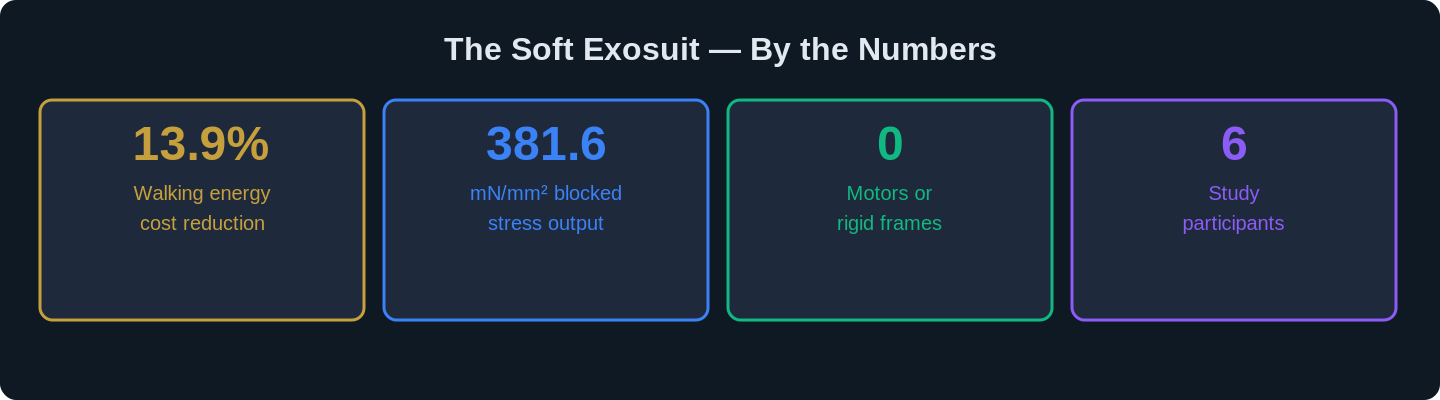
The suit is powered by dielectric elastomer actuators — thin, flexible materials that contract when electrically stimulated, behaving more like muscle than machinery. The longstanding problem: they were too weak to do useful mechanical work on a human body. The research team solved it by bundling fiber-shaped actuators together, reaching a blocked stress of 381.6 mN/mm² — a measure of force-generating capacity that finally clears the bar for wearable assistance, while staying soft and compact.
In a proof-of-concept trial with six participants, active hip assistance cut the net metabolic cost of walking by 13.9% — meaning walking became meaningfully less strenuous with no rigid structure strapped to the body.
Why EHS and ops teams should track this
This is not shipping next quarter. As the Exoskeleton Report notes, the sample is tiny and open questions remain around long-term comfort, durability, electrical safety and real-world performance — larger studies are still needed. But the direction matters to anyone specifying wearable assist technology:
- Weight and bulk trend toward zero — removing motors and frames makes all-day wear realistic, the #1 adoption complaint today
- New body locations open up — soft actuation can wrap hips and joints that rigid exoskeletons can't serve well
- Quiet operation — no gearbox whine, relevant for indoor and shared-space work
- Cost curve potential — fiber actuators are material science, not precision machining, once they scale
The takeaway
For procurement and safety teams, the practical read: keep current exoskeleton pilots on proven motorized or passive hardware, but watch soft-actuator research closely. The moment force density and durability numbers mature, the comfort argument that kills most exoskeleton programs disappears. Add 'soft-actuator roadmap' to your vendor conversations — the suppliers who can answer it are the ones planning past the current hardware generation.
There is a second-order effect worth watching: soft actuators change what 'wearing' a robot means. A device with no rigid frame can go on and off like a garment, which collapses the setup-time barrier that plagues current powered exoskeletons — the same complaint that derails real-world pilots today.
Sources: Science Advances; Exoskeleton Report