
Every year, U.S. employers spend an estimated $20 billion on costs related to workplace musculoskeletal disorders (MSDs) — the sprains, strains, back injuries, and cumulative trauma that occur when physical demands exceed the human body's capacity.
When you factor in lost productivity, retraining, overtime for replacement workers, and long-term health impacts, the total burden likely exceeds $50–100 billion annually across the U.S. economy.
The Scale of the Problem
Musculoskeletal disorders remain the leading cause of work-related disability worldwide, according to Fraunhofer IPA — and the problem is getting younger.
"Musculoskeletal disorders are no longer an issue limited to older workers — prolonged strain is triggering complaints early in workers' careers."
U.S. Workplace MSD at a Glance
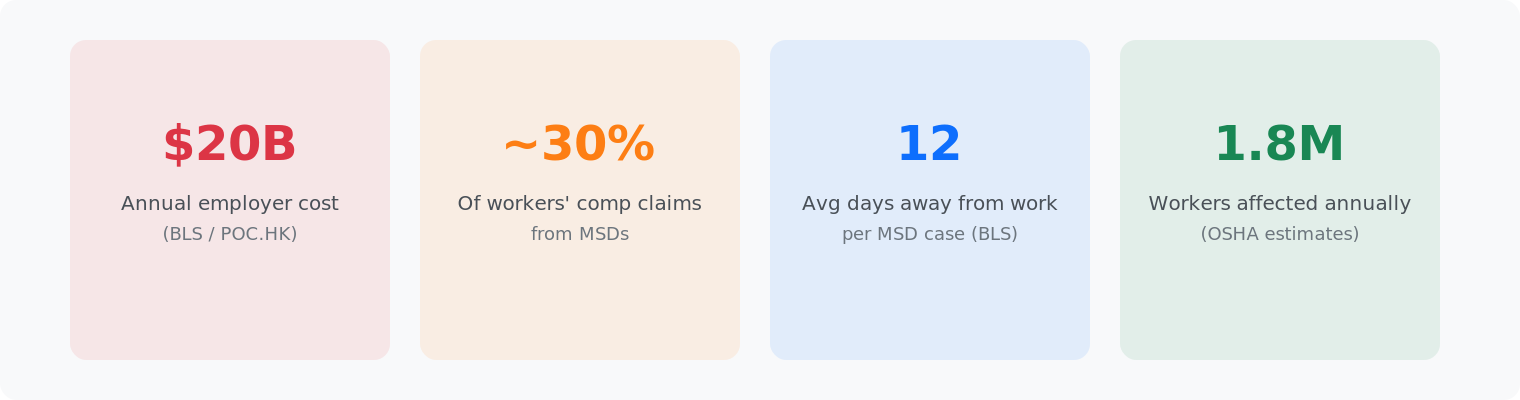
Bureau of Labor Statistics, POC.HK (May 2026), OSHA estimates
How Exoskeletons Change the Equation
A Santa Clara University study (February 2026) tested a passive back-support exoskeleton (Ottobock BackX) on 22 participants during manual handling tasks. The results were striking:
Perceived Exertion Reduction by Body Part (Borg Scale Points)
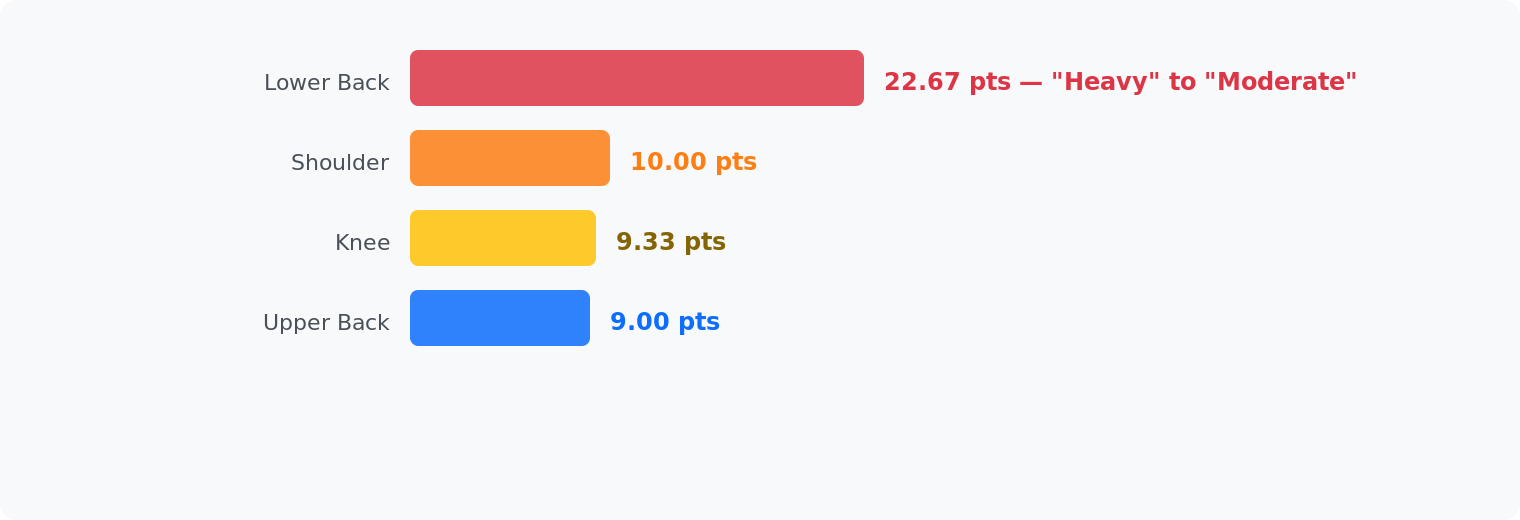
ASSEMBLY Magazine, "Can Exoskeletons Enhance Ergonomics in Manufacturing?" Feb 2026
The Hidden Cost of Doing Nothing
The math that matters to budget-conscious safety leaders:
Cost Comparison: One Injury vs. Prevention
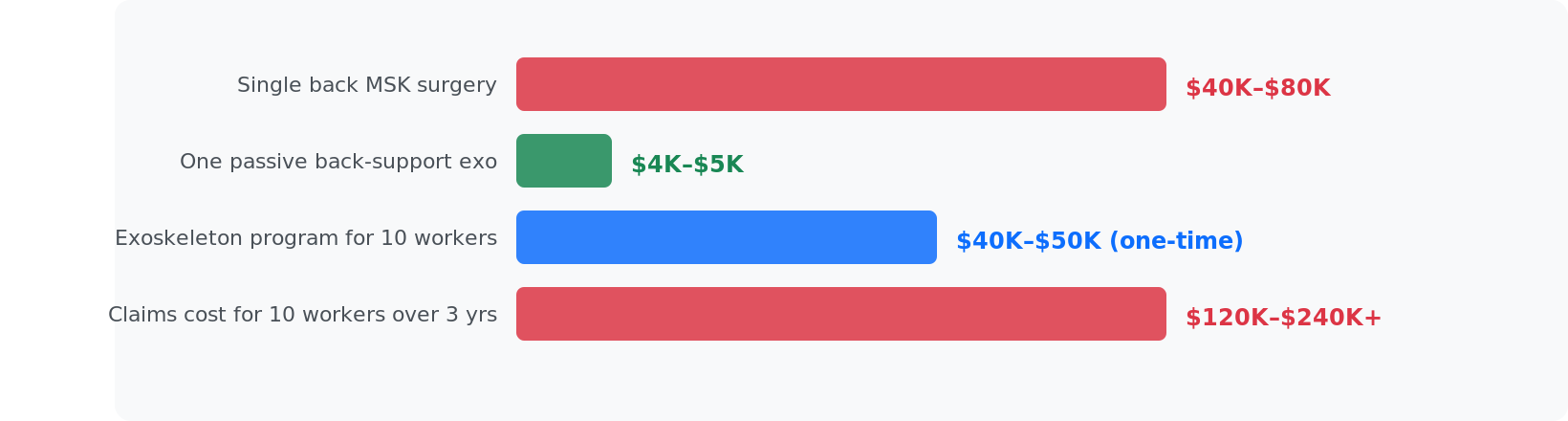
When a single back injury claim can cost more than equipping an entire work cell
When a single back injury claim can cost more than equipping an entire work cell with exoskeletons, the question shifts from "can we afford this" to "can we afford not to."
Data Gaps Worth Noting
Honest data reporting means acknowledging what we do not yet know. The research is encouraging, but:
⚠ Long-term biomechanical impact
Most studies cover 6 months or less. Multi-year studies are needed to confirm lasting effects.
⚠ Worker acceptance variability
Usage likelihood scored only 4.44/10. Deployment without worker buy-in underperforms.
⚠ Task-specific effectiveness
Walking and carrying showed less improvement than lifting. Not a universal solution.
⚠ Subjective vs. objective measures
Most studies rely on perceived exertion (Borg scale). More EMG and motion capture research needed.
The Workplace Ergonomics Brief is a weekly newsletter by Next Reality Robotics. We help safety leaders, HR professionals, and operations teams make data-driven decisions about worker augmentation.
Subscribe to the newsletter →