
Ask an operations manager why they have not tried an exoskeleton, and you will often hear the same objection: "They are too bulky, too rigid, and my team will not wear one for eight hours." It is an understandable reaction — early industrial exoskeletons were heavy, restrictive frames that looked more like movie props than workplace tools. But the technology that HexArmor and Verve Motion are now bringing to market is a different animal entirely, and the myth that exoskeletons cannot be worn all day no longer holds up against the evidence.
The Myth, Stated Fairly
The concern is legitimate. A device that restricts movement, traps heat, or fatigues the wearer will be left on the shelf — no matter how good its injury-reduction data. Worker acceptance is the single biggest predictor of whether an exoskeleton program succeeds or fails. So the question is not whether comfort matters; it is whether today's devices actually deliver it.
The Reality: Soft, Light, and Built for All-Day Wear
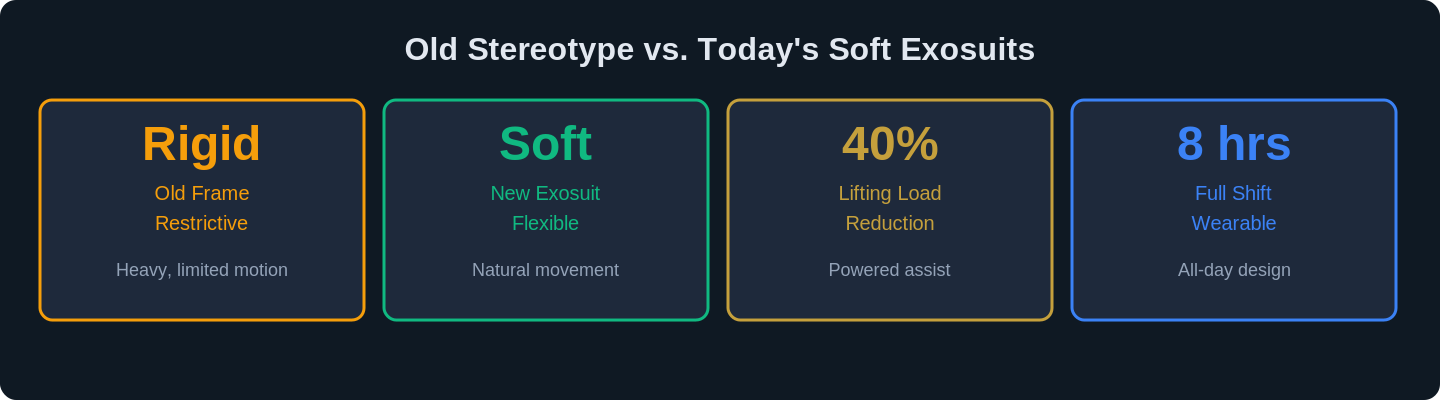
The newest generation of powered exosuits abandons the rigid-frame approach. FSM Magazine describes Verve Motion's SafeLift as a soft, lightweight, powered exosuit that uses motion sensors to detect a lift and a small motor to assist the lower back — reducing the physical load of every lifting motion by up to 40%. Critically, its flexible design lets workers bend, twist, and move naturally throughout a full shift, which is exactly what makes it practical for warehouses, distribution centers, and other all-day industrial environments. This is not a rigid robot bolted to the body; it is closer to a powered garment.
The Strongest Proof: Who Is Actually Wearing Them
If you want to test the 'too bulky' myth, look at who is adopting the technology. Aviation Pros reports that International Airlines Group — parent of British Airways and Iberia — is trialing shoulder-support exosuits on baggage handlers. Baggage handling is among the most physically demanding, repetitive, all-day jobs in any industry. If a soft exosuit were too cumbersome for full-shift wear, an airline group would never pilot it on the ramp. The fact that IAG is doing exactly that, with the explicit goal of improving worker comfort, is the myth being disproven in real time.
Industrial workers are performing physically demanding jobs every day, yet the technologies designed to protect and support them have not evolved at the same pace. Together, we believe exosuits will become a standard part of the industrial safety toolkit.
FAQ: What Workers Actually Ask
- Will it slow me down? Soft exosuits are designed to assist, not restrict — the motor engages only when sensors detect a lift, so normal movement is unaffected.
- Is it hot and heavy? Modern designs use lightweight textiles and a small motor, a fraction of the weight of older rigid frames.
- Will my team actually wear it? Comfort is the deciding factor, which is why vendors now prioritize all-day wearability — and why a full-shift pilot is the right way to find out.
The Takeaway
If your objection to exoskeletons is rooted in how they looked ten years ago, it is time for a reassessment. The devices now distributed by a global PPE leader and trialed by one of the world's largest airline groups are soft, lightweight, and engineered for comfort across a full shift. The best way to settle the question is not to debate it — it is to put a current-generation exosuit on a small group of workers for 30 days and ask them whether they would keep wearing it.
Sources: FSM Magazine; Verve Motion (press release); Aviation Pros