
Fines up to $161,000 show why employers need a practical ergonomics strategy before OSHA reviews their operations. JD Supra reports that OSHA uses the General Duty Clause to cite ergonomic hazards, even without a dedicated ergonomics standard. For EHS, HR, and operations leaders, the goal is to reduce risk in a way that is operationally realistic and financially defensible.
How OSHA can cite ergonomic hazards
The JD Supra analysis highlights that OSHA uses the General Duty Clause as the enforcement pathway for ergonomic issues, even though there is no standalone OSHA ergonomics rule. That means organizations should treat ergonomic hazards as compliance risks, not merely comfort concerns.
A defensible approach starts with visibility. Task assessments, injury and near-miss trends, worker complaints, and job demands should be recorded. If risks are left undocumented, leaders may struggle to show what was known and what corrective action was taken. Because ergonomic issues often accumulate over time, periodic reviews are as important as the initial assessment.
Exoskeletons are not an automatic fix
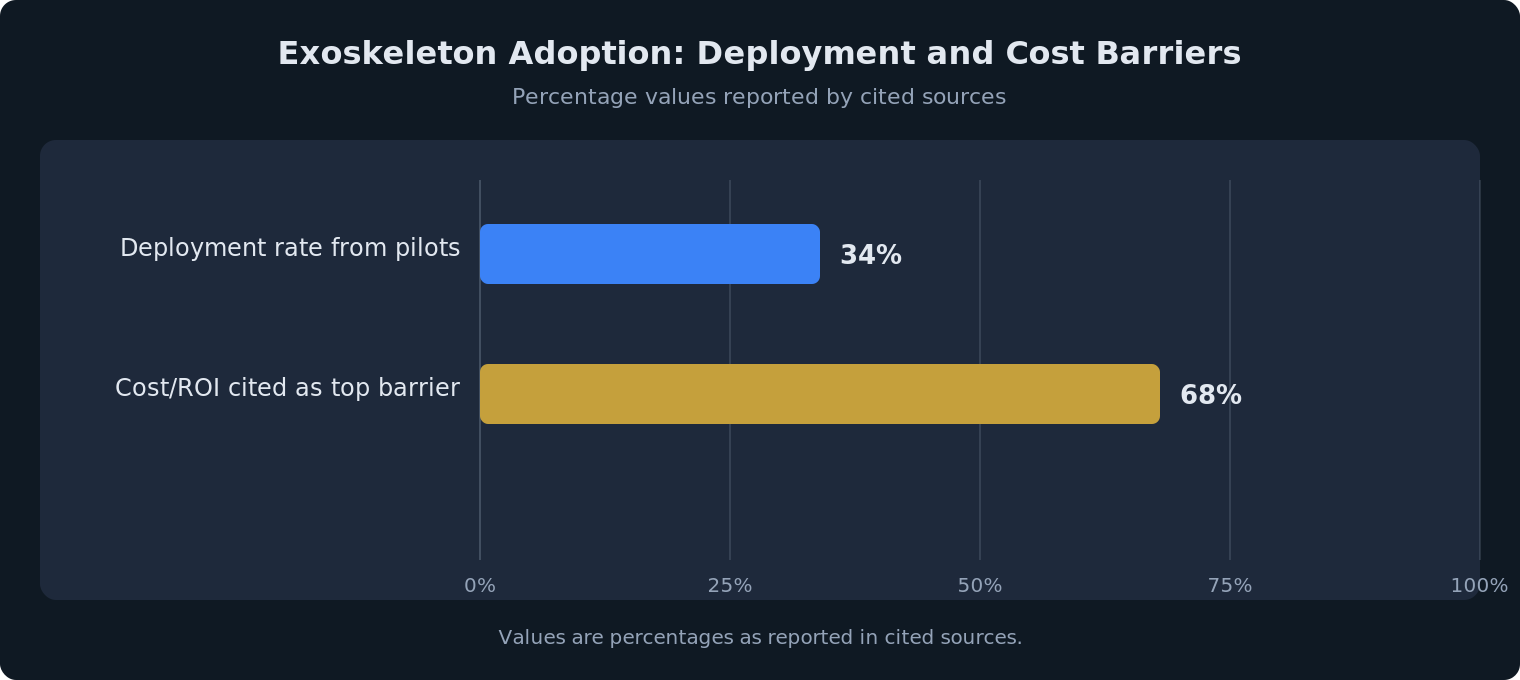
Exoskeletons can be part of a control strategy, but adoption evidence warns against assuming they solve the problem. A PLOS One study found that only 34% of exoskeleton pilots reached deployment. It also found that 68% cite cost and ROI as the top barrier.
Those figures matter because an expensive device that is not deployed consistently may fail to reduce exposure, while simpler controls may deliver better value. Safety leaders should compare exoskeletons with engineering changes, administrative controls, tooling, and workstation redesign before committing capital.
Build a practical ergonomics strategy
A compliance-ready ergonomics program should be specific enough to guide action and measurable enough to show progress. Key steps include:
- Identify high-risk tasks and document the basis for each assessment.
- Review injury and near-miss data for patterns.
- Involve workers in selecting and testing controls, including exoskeletons.
- Evaluate cost, training burden, maintenance, and likely usage before scaling.
- Keep records of decisions, training, and follow-up evaluations.
This approach does not promise immunity from citations, but it gives organizations a clearer record of diligence. It also prevents the common mistake of buying technology first and asking whether it fits the work later. The stronger path is to match the control to the hazard, then verify that workers can and will use it.
Takeaway for safety and operations leaders
OSHA's General Duty Clause makes ergonomics a live enforcement issue, and penalties can be substantial. The strongest response is not a single technology purchase. It is a documented, worker-informed process that matches controls to hazards, tests solutions carefully, and respects the cost and adoption barriers shown in the exoskeleton data.