
Passive exoskeletons — no motors, no batteries, just springs and dampers — keep getting pitched as the low-cost, low-maintenance answer to overhead-work injuries. But the honest question for any EHS or operations leader is: where do they actually deliver? A new peer-reviewed study published in Applied Sciences by researchers at Peking University's School of Public Health takes a meaningful step toward an answer, testing a passive upper-limb exoskeleton on three real power-grid maintenance tasks and measuring exactly which muscles get relief — and which don't.
How they tested it
The team used a randomized crossover design — the gold standard for this kind of work — with 22 healthy participants who each performed three representative utility tasks both with and without the exoskeleton: insulator installation, insulated rod handling, and hand-chain hoist operation. Surface electromyography (sEMG) quantified muscle activity as a percentage of maximum voluntary contraction (%MVC), while subjective fatigue (Borg CR-10), workload (NASA-TLX), and usability (the System Usability Scale, or SUS) captured the human experience. That combination of objective muscle data and subjective ratings is what makes the findings actionable rather than academic.

The key finding: static wins, dynamic limits
In the static tasks — the sustained, held-posture work that defines overhead utility maintenance — the exoskeleton significantly reduced muscle activity in the trapezius, deltoid, and biceps brachii. In the dynamic task, the benefits narrowed: significant reductions showed up mainly in the deltoid and trapezius, and primarily during the arm-raising phase. Participants also reported less local discomfort in the shoulders, elbows, and wrists, and lower scores on the physical-demand and effort dimensions of workload. The usability picture was encouraging too — a mean SUS of 74.2 lands in the acceptable-to-good range, suggesting workers wouldn't fight wearing it.
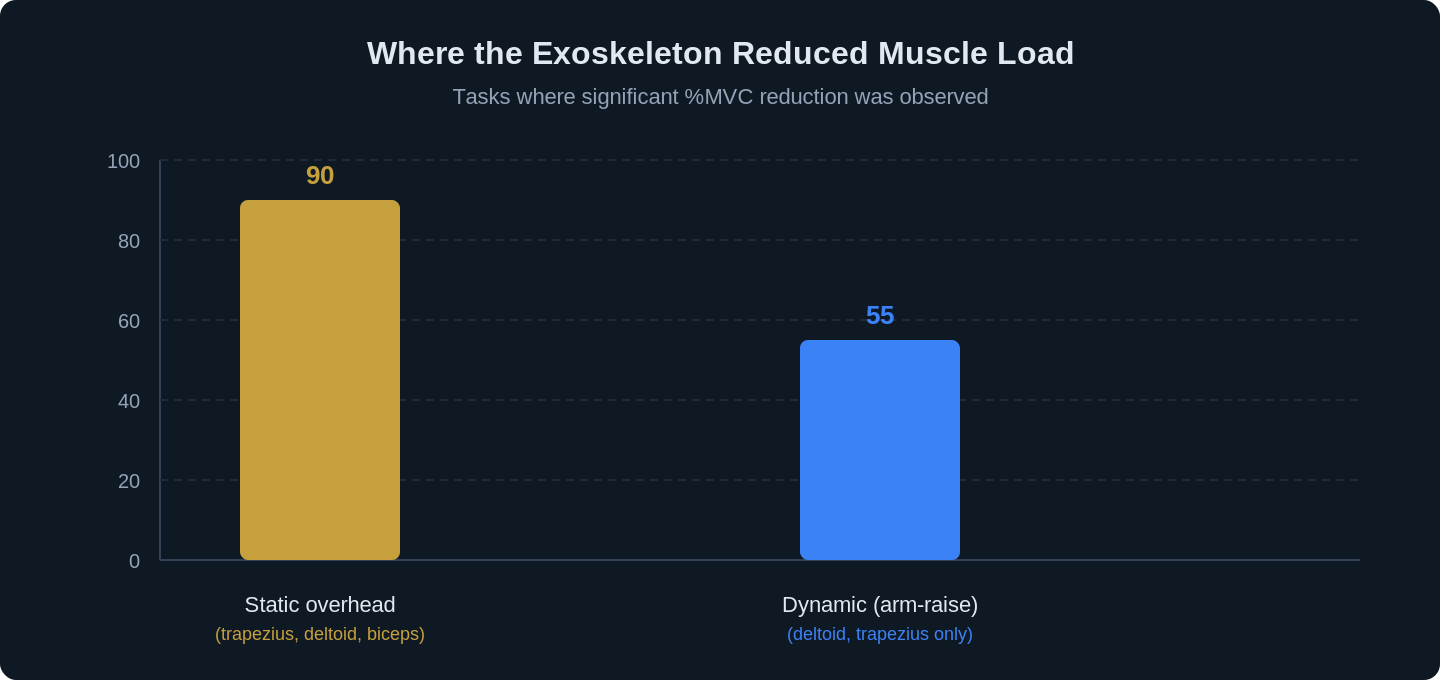
The passive upper-limb exoskeleton can effectively reduce proximal upper-limb loading in power grid maintenance tasks, with the greatest benefit observed in static overhead work.
So what: match the device to the task, not the other way around
The practical read for anyone specifying exoskeletons is that task profile should drive the purchase. If your workforce does sustained overhead or held-posture work — utility line maintenance, aircraft assembly, ceiling installation, welding in fixed positions — a passive shoulder device is well-supported by this evidence and carries the cost and maintenance advantages of having no electronics. But if the job is fast and dynamic — frequent reaching, varied angles, quick cycles — temper your expectations; the benefit shrinks and may not justify the spend. The study's caveats are real (22 young, healthy participants in controlled conditions), so validate on your own crew. Still, this is the kind of task-specific, muscle-level evidence that lets you stop guessing and start matching the right augmentation to the right job.
Sources: Applied Sciences / MDPI (Jin, Wang & He, 2026)