
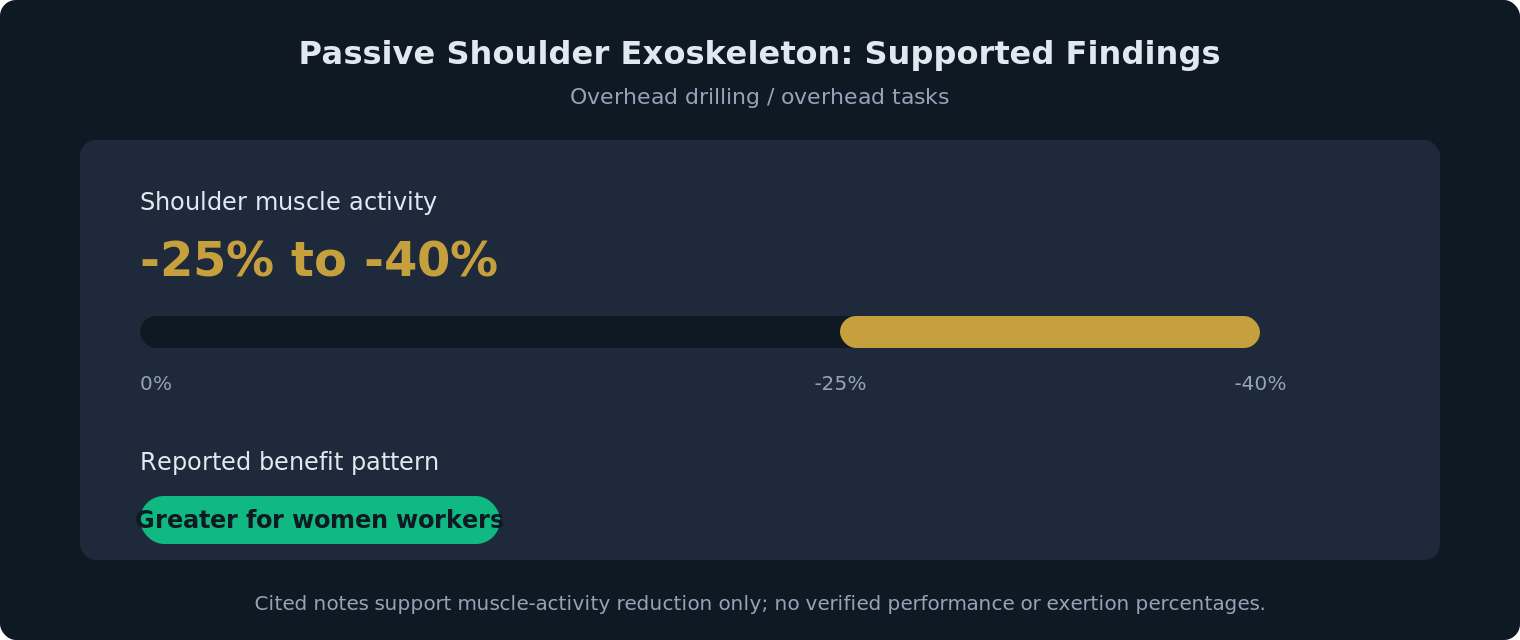
Overhead drilling is one of the fastest ways to load the shoulders, and new evidence suggests passive exoskeletons may help where the strain is highest. A June 2026 study in Nature reports that passive shoulder exoskeletons reduced shoulder muscle activity by 25-40% during overhead tasks and delivered greater benefits for women workers.
The finding matters because the reported benefits were not uniform across all workers. Instead, the study points to a clearer ergonomic signal for women workers in the tested overhead task. For safety and operations leaders, that makes device fit and inclusive trial design part of the performance conversation, not an afterthought.
What the study supports
Researchers examined overhead drilling, a common activity in construction and manufacturing, and assessed shoulder muscle activity with and without a passive shoulder exoskeleton. The clearest supported result is the 25-40% reduction in muscle activity. The study also points to greater benefits for women workers, so it should not be framed as a women-only test unless the full paper confirms that design.
Earlier summaries that included fixed percentages for drilling performance or perceived exertion are not supported by the cited source notes. Those figures should not be used in procurement, safety claims, or business-case materials until the full study details can be verified.
Why this matters on the shop floor
Lower shoulder muscle activity is a promising biomechanical signal, but it does not automatically prove fewer cumulative trauma injuries, lower absenteeism, or a financial return. Those outcomes require longer observation, field samples, and tracking of comfort, usability, and task quality.
The practical value is more targeted. A passive shoulder exoskeleton may be worth piloting where workers repeatedly perform overhead drilling or similar shoulder-intensive tasks. It is not a universal fix for every job, posture, or body type.
How to apply the evidence
Research from NIOSH on exoskeleton biomechanics emphasizes that effectiveness varies by task type and worker anthropometry. That caveat should shape deployment decisions. A device that helps with one overhead task may not help with assembly, material handling, or constrained postures.
- Pilot the exoskeleton on a defined overhead task, not across all jobs.
- Include women and men in the trial and check fit across body sizes.
- Track shoulder discomfort, task quality, cycle time, and worker acceptance.
- Use the NIOSH guidance to match the device to the task before scaling.
The bottom line
The Nature study adds meaningful evidence that passive shoulder exoskeletons can reduce shoulder muscle demand during overhead drilling and may be especially helpful for women workers. For HR, EHS, and plant leaders, the takeaway is measured adoption: match the device to the task, verify fit across your workforce, and collect field data before making injury-reduction or productivity claims.