
Manufacturers are watching two parallel automation paths. One is the heavily funded push toward humanoid robots. The other is the quieter deployment of worn and assistive tools that change the physical demands of existing jobs. These paths are not mutually exclusive, but they carry different levels of evidence for safety and ergonomics teams.
Capital Is Real, Proof Is Still Limited
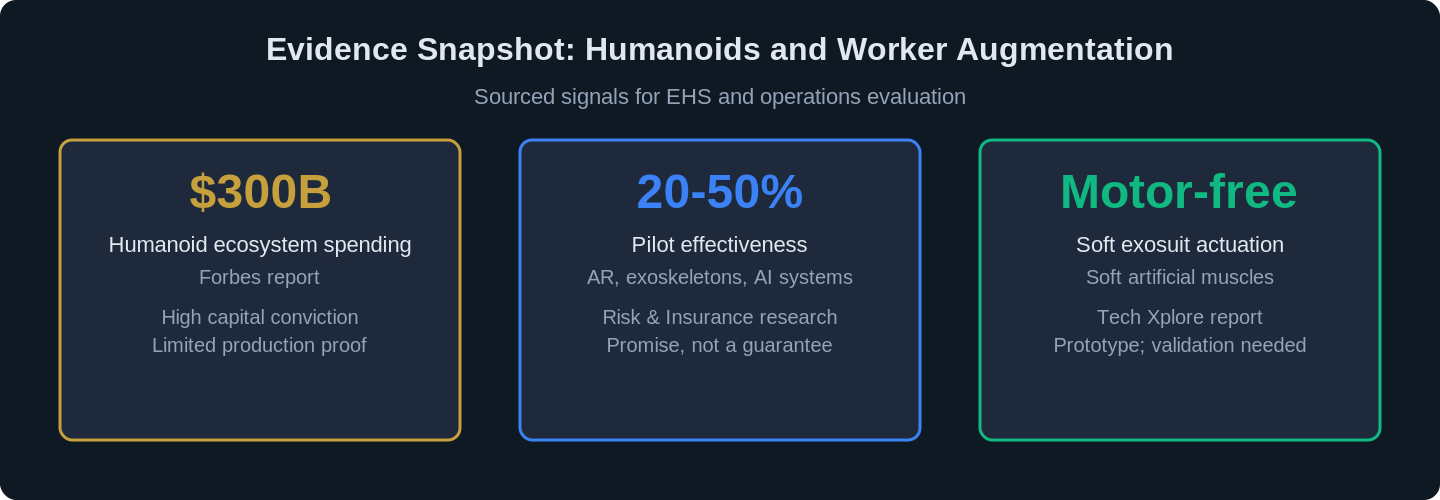
Forbes reports approximately $300 billion in humanoid ecosystem spending. That level of capital shows serious industry interest and should not be dismissed. Yet near-term proof remains limited. Jeff Burnstein of the Association for Advancing Automation says the sector is “heavy in the hype cycle” and points to a narrow production footprint.
Burnstein’s broader point is about factory technology generally: “We just need things that work, things that are proven reliable, affordable.” That standard is useful when evaluating both humanoids and augmentation, but it does not by itself prove that any specific exoskeleton is ready.
Motor-Free Exosuits: A Prototype Worth Watching
A separate development shows where augmentation research is heading. Tech Xplore reports that researchers in China developed a soft robotic exosuit driven by soft artificial muscles rather than traditional motors. The disclosed capability is motor-free actuation for walking assistance, with potential relevance for older adults, injured workers, and people performing physically demanding tasks.
- Actuation: soft artificial muscles, with no traditional motors.
- Function: walking assistance.
- Reported users: older adults, injured workers, and people doing physically demanding tasks.
- Status: research breakthrough; no published weight, torque, energy reduction, cost, or certification data.
The report does not provide industrial durability, workplace validation, or deployment evidence. For an EHS or operations leader, that means the exosuit is a promising prototype, not a validated plant-floor product. Removing motors and batteries could reduce weight and maintenance complexity, but industrial validation is still required.
What the Evidence Supports Today
For current deployment, the most concrete evidence is modest. Risk & Insurance reports research finding that AR tools, exoskeletons, and AI systems show promise for reducing musculoskeletal injuries, with pilot effectiveness in the 20% to 50% range. That is meaningful, but it is not a guarantee of injury reduction in every environment.
Adoption barriers remain real: worker acceptance, heat, discomfort, cost, training, and mixed pilot results can determine whether a device succeeds or sits in a locker. Humanoids add another layer of uncertainty because no humanoid-specific safety standard exists, and insurers and OSHA are likely to scrutinize deployments. Most working humanoid robots are kept away from people with gates or fences.
Practical Takeaway
For EHS and operations leaders, the practical approach is not to pick a winner in a false race. Start with ergonomics problems that have measurable costs today. Pilot augmentation tools where the evidence is strongest, collect task-specific data, and treat soft exosuits as research to monitor. Keep humanoid automation on the radar, but do not assume it will solve near-term ergonomic risk without safety standards and production proof.
The humanoid future may arrive. Today’s safer bet is disciplined evaluation: quantify the task, test the tool, and scale only when the pilot data support it.