
Data & Research | 2026-06-30
The question: How much do work-related musculoskeletal disorders cost employers, and which prevention claims are robust enough to guide budgets?
The scale of the problem
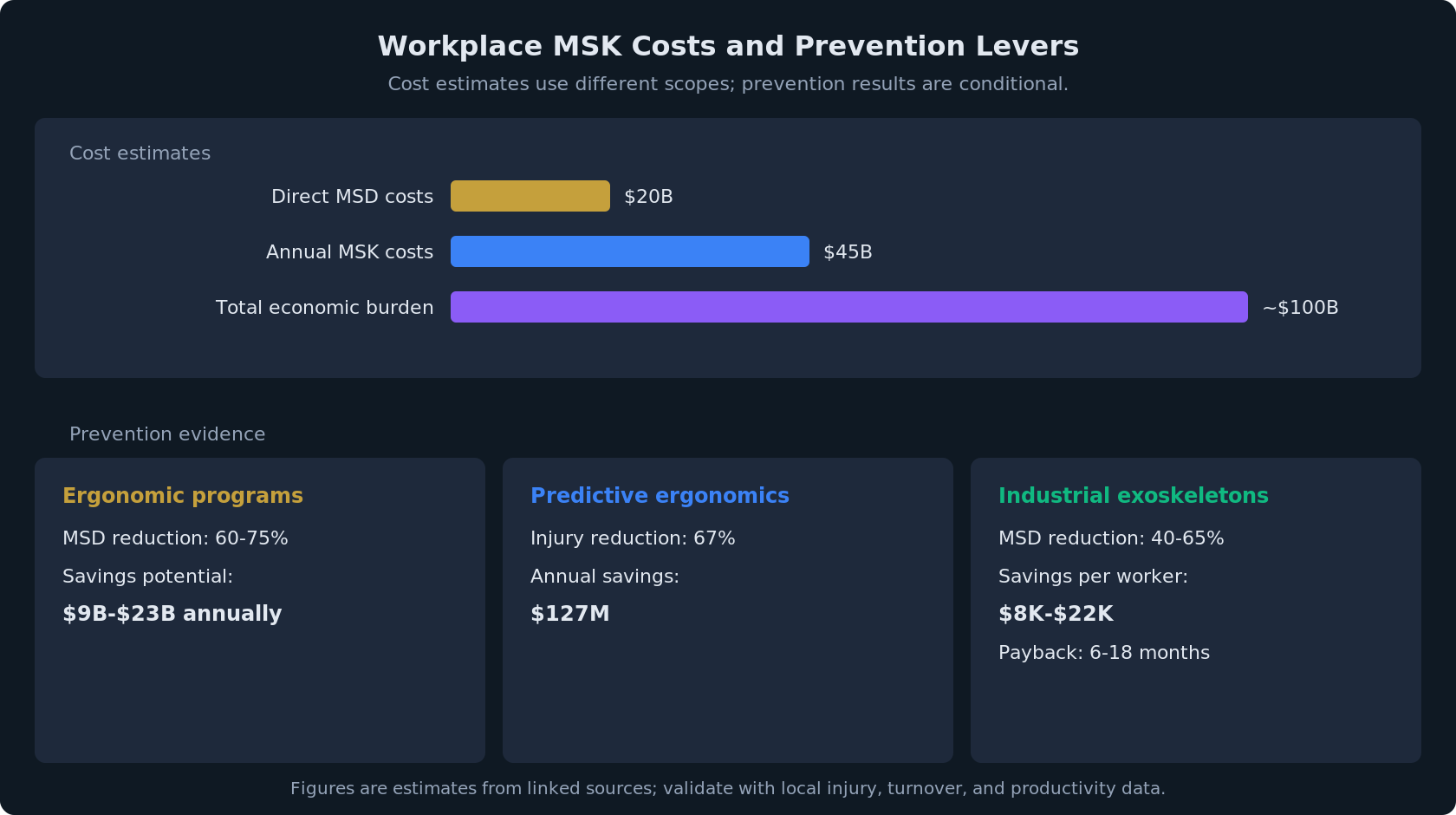
Musculoskeletal disorder data is persuasive, but it is not one single number. OSHA Ergonomics Best Practices in Manufacturing estimates direct MSD costs at about $20 billion and indirect costs at three to five times direct. That implies a total economic burden of roughly $100 billion, but it is a broad estimate, not a universal cost for every employer.
A separate Worker Wellness: NIOSH Updated 2026 Playbook for Break Design cites $45 billion in annual MSK costs, 38% of lost workdays, and a possible 60% reduction. These figures use different scopes: direct costs, annual MSK costs, and total burden including indirect effects. They should not be added together or treated as interchangeable. For budgeting, reconcile public estimates with your own injury rates, turnover, absenteeism, and productivity losses.
What prevention can change
The prevention evidence is strong, but results depend on baseline risk, task selection, implementation quality, worker acceptance, training, and follow-through. Workplace Ergonomics Statistics by Productivity and Facts reports that ergonomic programs reduce MSDs by 60-75% and cites $9 billion to $23 billion in annual savings potential. That is a useful planning range, not a guaranteed 12-month outcome.
Worker Wellness: Latest 2026 Trends in MSK Injuries reports a 67% injury reduction with predictive ergonomics and $127 million in annual savings. Treat this as an emerging result. Compare predictive tools against your current ergonomics program before assuming incremental benefit.
Industrial Exoskeleton ROI — MarketIntelo cites MSD rate reductions of 40-65%, annual savings of $8,000 to $22,000 per protected worker, and payback in six to 18 months. Payback depends on injury baseline, unit utilization, number of protected workers, and how productivity is measured. Poorly fitted or poorly adopted systems may deliver lower savings.
Key takeaway
Build the business case with your own data. Pilot interventions on high-risk tasks, validate injury and productivity changes, document assumptions, and expand only where local results support the investment.
2026 implementation priorities
The 2026 conversation is moving toward proactive risk assessment. The linked Logifit trends article highlights predictive ergonomics, but employers should compare new tools against existing baselines. Identify high-risk tasks, apply engineering and administrative controls, measure outcomes, and expand only where data supports it.