
The Exoskeleton Tipping Point: Why 2026 Is the Year Worker Augmentation Goes Mainstream
Something changed in the first half of 2026. Three supported signals show why exoskeletons are receiving more serious safety-budget discussion, while the evidence base is still maturing.
Market Estimates Are Expanding, but They Are Not Interchangeable
A conservative forecast from ResearchAndMarkets.com projects the global exoskeleton market at $2.03 billion by 2030, with a 29.4% compound annual growth rate. POC.HK offers a broader scenario: workplace adoption could exceed $10 billion by 2030. The gap is a reminder to treat these figures as different scopes and assumptions, not as a single confirmed number.
2030 Market Estimates: Conservative vs Broad Adoption (qualitative scale)
Sources: ResearchAndMarkets.com, POC.HK
Three Recent Signals Worth Watching
1. Certified, lighter hardware
Comau Press Release: MATE-XT GO is a Category II PPE-certified passive exoskeleton under 3 kg, listed at $4,295.
2. Investor activity
TAMradar reported a €5M Series A round in April 2026.
3. Early field evidence
Construction Executive reported 30% less back strain with the Hapo Back exoskeleton; POC.HK cites multiple workplace case studies.
Supported Workplace Signals
One specific result cited in these sources is construction work using the Hapo Back exoskeleton, where Construction Executive reported 30% less back strain. POC.HK points to additional case studies, and The Robot Report tracks broader manufacturing worker-augmentation trends.
Supported Workplace Signals (qualitative, not scaled)
Sources: POC.HK, Construction Executive, The Robot Report, Comau Press Release
What Is Driving the Shift — and What Still Needs Proof
Comau Press Release shows practical thresholds:
- <3 kg weight
- Category II PPE certification
- $4,295 price point
- Passive exoskeleton design
- TAMradar: €5M Series A
- The Robot Report: augmentation trends
- POC.HK: workplace case studies
- Construction Executive: 30% less back strain
- Results are task- and workforce-specific
- ROI requires local measurement
Why This Matters:
Exoskeletons are not a universal fix. Buyers should weigh unit cost, worker acceptance, task fit, and local safety review. The practical path is to test narrowly, measure honestly, and scale only where the data supports it.
What This Means for Safety, HR, and Operations Leaders
If you are responsible for workforce safety or operational efficiency, treat exoskeletons as an emerging tool, not a guaranteed fix. Choose one high-risk task, define baseline discomfort and injury metrics, involve workers and ergonomists, then run a time-boxed pilot. Track usage, acceptance, productivity, and incident data before deciding whether exoskeletons belong in your standard safety toolkit.
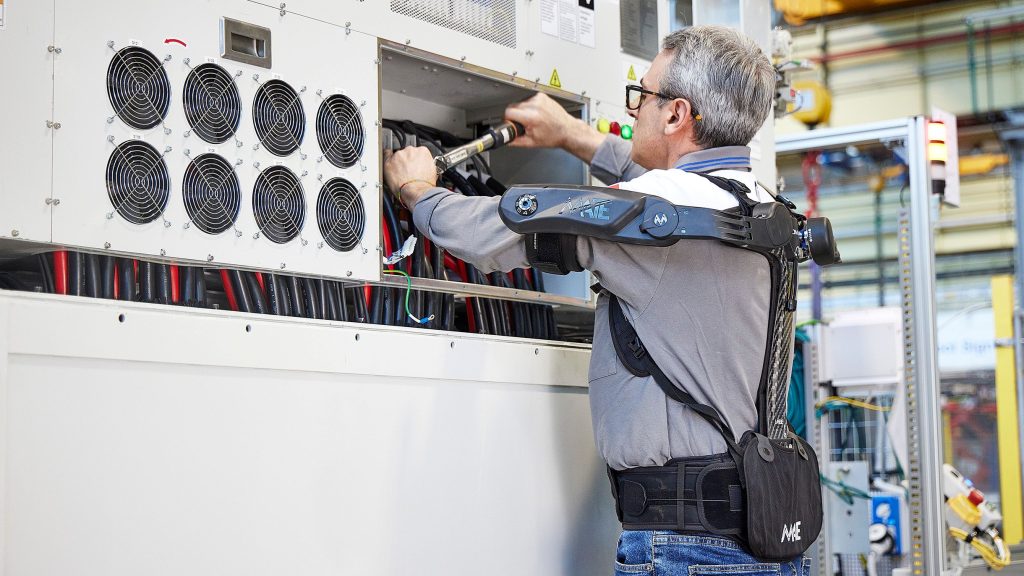
MATE-XT GO ergonomic movement. Source: Comau Press Release.
The Workplace Ergonomics Brief is a weekly newsletter by Next Reality Robotics. We help safety leaders, HR professionals, and operations teams stay ahead of the worker augmentation revolution.
Subscribe to the newsletter →