
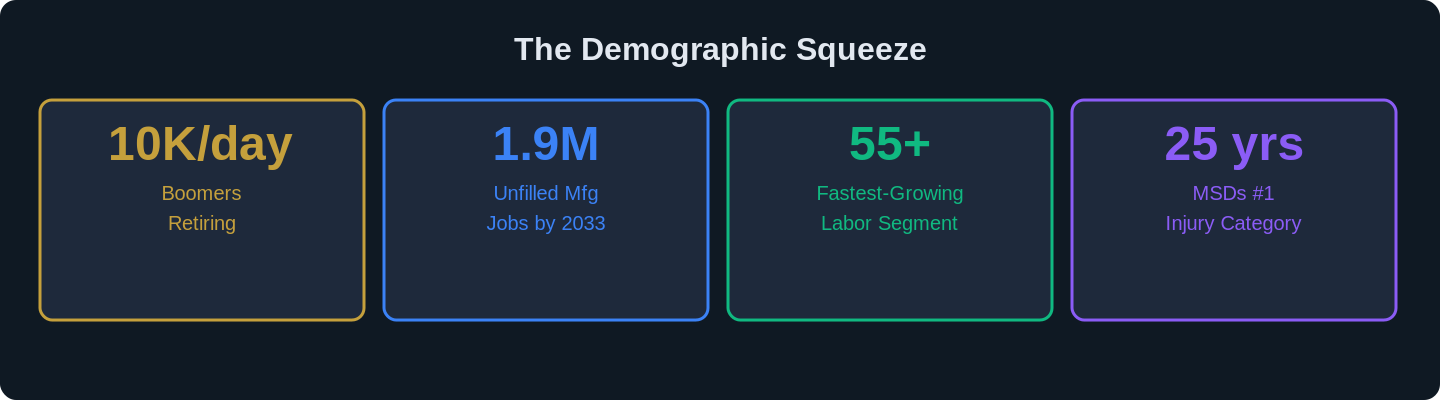
Forget the AI displacement headlines. According to Indeed chief economist Svenja Gudell, America's most urgent labor market threat is demographic: Baby Boomers are retiring at a rate of roughly 10,000 per day, and no amount of AI investment replaces the physical labor they leave behind. For operations leaders in manufacturing, construction, warehousing, and logistics, this isn't a future problem — it's the reason your open requisitions stay unfilled and your workplace ergonomics program just became a retention strategy.
The Numbers Are Staggering
The U.S. Bureau of Labor Statistics projects that workers aged 55+ will be the fastest-growing segment of the labor force through 2032. Meanwhile, the manufacturing sector alone faces an estimated 1.9 million unfilled jobs by 2033 (Deloitte/MAPI). The Fortune report underscores that this isn't a skills-gap problem alone — it's a physical-capacity problem. Older workers carry disproportionate rates of musculoskeletal disorders, and the jobs they're leaving are the same jobs that break younger workers' bodies within five years.
Why This Is an Ergonomics Problem, Not Just an HR Problem
When your experienced workforce walks out the door, they take institutional knowledge that no onboarding program fully replaces. The workers who replace them are less experienced, more injury-prone, and — in a tight labor market — harder to retain. Workplace ergonomics becomes the lever that keeps both groups productive: reducing the physical toll that drives older workers into early retirement and preventing the injuries that cause newer workers to quit within their first year.
This is exactly the use case where exoskeletons and worker augmentation technology stop being nice-to-have innovation projects and become workforce-sustainability infrastructure. A passive shoulder exoskeleton that extends a 58-year-old technician's career by five years is worth far more than the device's purchase price — especially when the alternative is six months of unfilled requisitions and overtime burnout for the rest of the team.
What Operations Leaders Should Do Now
- Model your workforce age distribution against retirement eligibility — identify the 3-year cliff
- Track MSD injury rates by tenure cohort; new hires in physical roles typically spike at months 3–9
- Evaluate exoskeleton and ergonomic interventions as retention tools, not just safety compliance
- Build the business case in terms of replacement cost: $4,000–$15,000 per hourly worker (SHRM estimates)
Bottom line: The aging workforce isn't a headline to worry about — it's a capital-allocation decision to make now. Every quarter you delay an ergonomics investment is a quarter where your most experienced workers are one injury away from retirement, and your newest workers are one strain away from a resignation.
Sources: Fortune — Indeed Chief Economist: Aging Baby Boomers Are America's Real Labor Problem (Jul 18, 2026); Deloitte/MAPI Manufacturing Skills Gap Report; BLS Labor Force Projections