
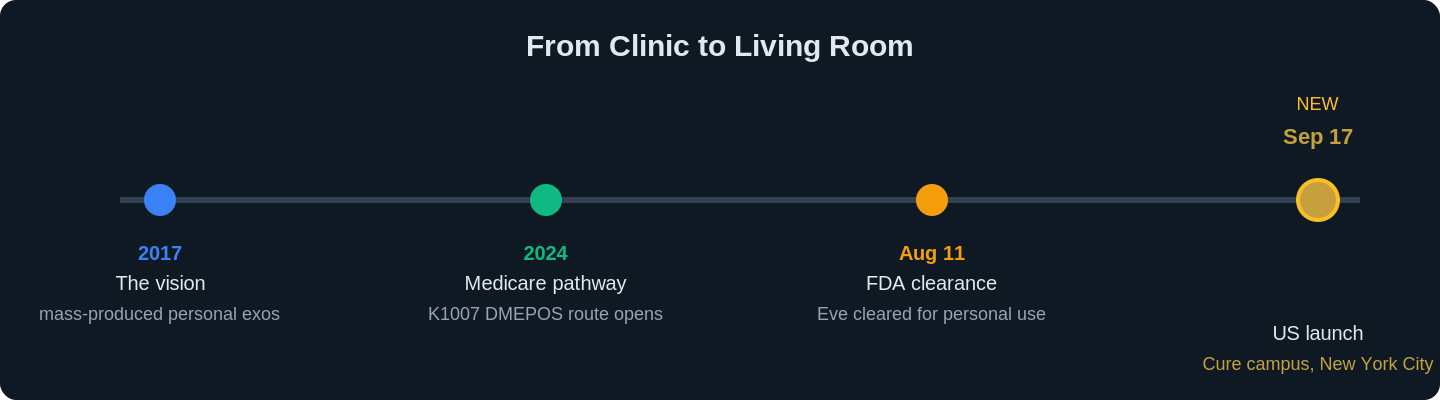
Personal exoskeletons have been stuck in a gap for a decade: too capable to dismiss, too clinical to live at home. On August 11 the U.S. Food and Drug Administration closed part of that gap, clearing Wandercraft's Eve for prescribed personal use — a hands-free, self-balancing walking exoskeleton for eligible adults with spinal cord injuries at any level. A U.S. commercial launch is planned for September 17, 2026.
What the clearance actually covers
According to the Exoskeleton Report, Eve may be used by eligible adults with spinal cord injuries at any injury level, provided the user can operate the device's remote control — an unusually broad description for personal exoskeletons. Eve's active self-balancing means no crutches or walker: the user's hands stay free for reaching, carrying objects, preparing food, and moving through tight spaces. The clearance is nonetheless specific. Use is limited to level indoor surfaces and level outdoor areas immediately adjacent to a building, such as patios, always under the supervision of a specially trained companion. Wandercraft is explicit that Eve complements the wheelchair rather than replacing it.
The infrastructure may matter more than the hardware
Wandercraft is assembling the service network that personal use demands: Walk US will support evaluations and training; National Seating and Mobility is the exclusive complex rehabilitation technology distribution partner; Good Shepherd Rehabilitation supports access in Pennsylvania's Lehigh Valley; and USVetServ will distribute Eve and Atalante X to Department of Veterans Affairs facilities. Prospective users complete a clinical assessment, an individualized fitting, and five two-hour training sessions covering transfers, remote operation, level-surface walking, activities of daily living, and emergency procedures. The clearance was supported by a three-site trial through the James J. Peters VA Medical Center in the Bronx, Kessler Foundation, and Walk in New York. Meanwhile Atalante X, the rehab predecessor, already operates in more than 150 rehabilitation and research centers worldwide.
The Medicare question
Medicare created a more viable reimbursement pathway for qualifying personal exoskeletons in 2024 by treating certain systems as braces under the DMEPOS program. As Wandercraft notes, Eve is projected to become eligible under the established K1007 pathway within 60 to 90 days — though individual coverage still depends on documentation, medical necessity, and payer decisions.
For occupational health teams watching exoskeleton adoption, Eve matters as a signal. Regulatory clearance is no longer the bottleneck for wearable robotics — assessment, training, reimbursement, fitting, repair, and long-term service are. The same lesson applies on the industrial side: pilots succeed or fail on onboarding and support, not on the spec sheet.
Sources: Exoskeleton Report; Wandercraft press release