
The $100 Billion Burden: Workplace MSK Injuries by the Numbers
Data & Research | 2026-06-30
📊 The Question: How much do work-related musculoskeletal disorders (MSDs) really cost employers, and what difference can ergonomic interventions make?
The Scale of the Problem
Musculoskeletal disorders remain the single largest category of workplace injury in the United States. According to OSHA 2026 data, MSK injuries account for 38% of all lost workdays across high-risk industries. The direct medical and compensation costs reach approximately $20 billion annually — but that is just the visible tip of the iceberg.
Research from the Ergonomics Center at NC State University shows that indirect costs — lost productivity, replacement worker training, increased insurance premiums — are 3 to 5 times higher than direct costs. The true economic burden of workplace MSDs in the US likely exceeds $100 billion annually.
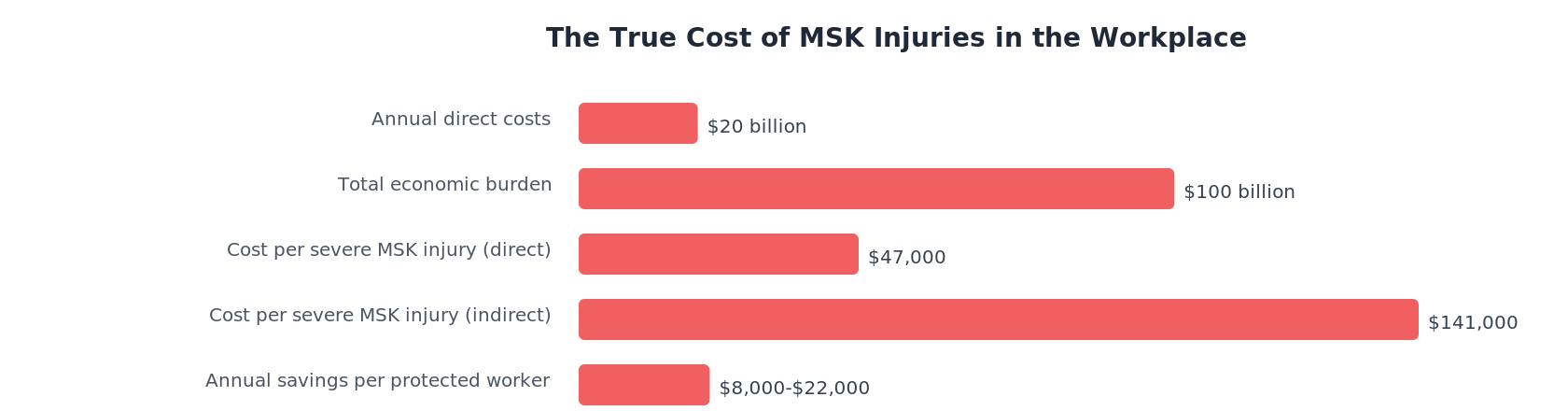
Sources: OSHA 2026, NC State University Ergonomics Center, NIOSH 2026 update, QualityZe/Market.biz
Which Industries Are Hit Hardest?
Not all industries face equal risk. Mining leads with 4.8 MSK cases per 100 full-time workers, followed by construction (4.2) and heavy transport (3.7). Critically, 73% of MSK injuries in mining occur during the first 4 hours of a shift, when accumulated fatigue compromises natural ergonomics (MSHA 2026 data).
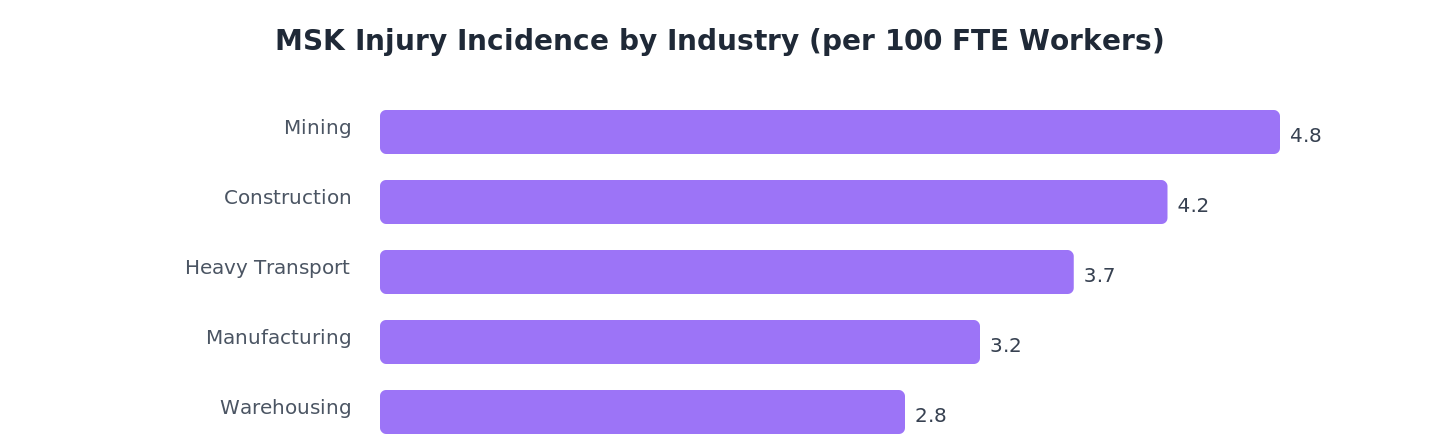
Source: NIOSH 2026 update, Logifit analysis of OSHA/MSHA data
The Case for Prevention
The good news: ergonomic interventions work, and the ROI is measurable. Studies consistently show that comprehensive ergonomic programs reduce MSK injuries by 60-75% within 12 months. For passive exoskeletons priced at $2,000-$5,000 per unit, field studies document payback periods of 6-18 months, with average annual savings per protected worker ranging from $8,000 to $22,000 when accounting for direct injury costs and productivity losses.
For every dollar invested in ergonomic safety programs, employers save between $9 and $23 in compensation costs, according to industry analysis. Companies with advanced health, safety, and environmental systems report 73% fewer lost days due to MSK injuries.
🔑 Key Takeaway: The numbers are unambiguous. Workplace MSK injuries are a $100B problem that ergonomic interventions — including exoskeleton programs — can reduce by 60-75%. With payback periods under 18 months and savings of up to $22,000 per protected worker annually, the business case writes itself.
2026 Trends in Ergonomic Technology
The data also shows a rapid shift toward predictive ergonomics. Between 2023 and 2025, requests for ergonomic risk calculation increased by 75%. NIOSH's 2026 updated playbook integrates real-time fatigue monitoring with ISO 45001 management frameworks. AI-driven platforms are developing personalized ergonomic interventions that adapt over time. Wearable systems with smart insoles and wristbands now measure vertical load location during manual lifting in real time.
The message from the data is clear: prevention is not just cheaper than treatment — with modern predictive technology, it is also more effective than ever before.
💡 Want to Learn More?
Next Reality Robotics helps organizations evaluate, pilot, and deploy workplace exoskeleton solutions. Subscribe to The Workplace Ergonomics Brief for weekly insights delivered to your inbox.